New Charter School In Holyoke Builds Social Justice Curriculum
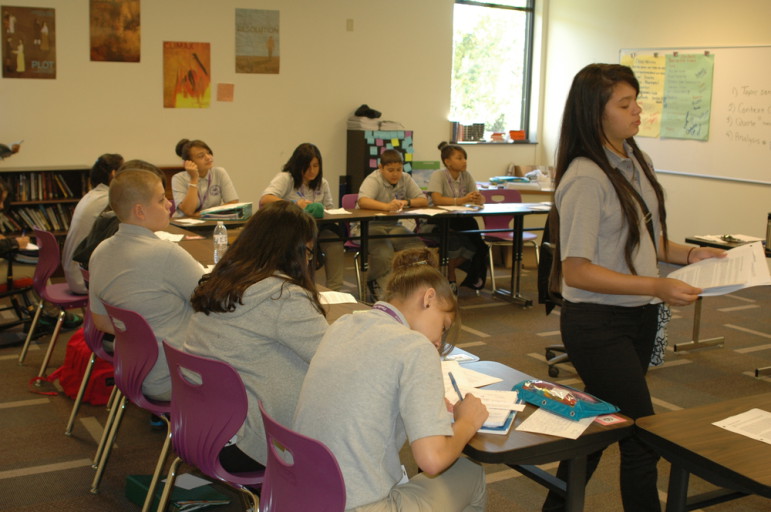
At the Paulo Freire Social Justice Charter School in Holyoke, Mass. teacher Kira Jewett prepares 9th grade biology students for the day with a warm-up question: “Is there anything in your life you want more of? Less of?”
Jewett’s students are studying osmosis and she wants them to think about how molecules reach equilibrium -- balancing positive and negative -- by thinking about their own lives. Later, in math class, students discuss deductive reasoning while comparing the income rates of countries around the world.
These lessons are part of a social justice curriculum championed by Ljuba Marsh and Bob Brick who opened the school in September with 152 students in grades 9 and 10.
In the next two years Brick and Marsh will expand to include 11th and 12th grades, increasing enrollment to between 450 and 500 students mostly from Springfield, Chicopee, South Hadley, Northampton, West Springfield and Holyoke.
Students in these districts struggle academically; last year, in all six districts, except Northampton, 10th grade students’ MCAS results were all in the bottom 25 percent.
Holyoke, which performed in the bottom 5 percent of MCAS tests for grade 10, also had the highest dropout rate of any non-charter district in the state, according to data from the Massachusetts Department of Education.
Holyoke Schools Superintendent Sergio Páez welcomed PFSJ to the community.
“I welcome the competition but I hope that we can all provide better services,” he said.
PFSJ was funded with a $290,000 start-up grant from the federal government. The school also receives, on average, $13,000 in state funding for each student, Marsh said, and grants from public foundations including the Beveridge Foundation, Mifflin Memorial Fund, the Irene E. & George A. Davis Foundation.
That funding helps the school provide extra lessons and support for students’ families. At the lunch period, students can attend classroom discussions on topics like environmentalism and activism. Four days a week, the school offers free courses on topics like health and American Sign Language for students’ families. Throughout the week, the school operates a food pantry where needy students’ families can take resources from the Food Bank of Western Massachusetts.
The school adheres to the framework of the Common Core for English Language Arts and Mathematics and the state’s Curriculum Framework, said Marsh.
The Curriculum Framework offers guidelines, not a mandate, for what students should know and be able to do in different subjects and grade levels, said JC Considine, Chief of Staff for the Massachusetts Department of Elementary and Secondary Education.
Despite coming from low performing districts, Marsh expects students will earn high marks on their March MCAS. Results from the test are expected in September; it will be the school’s first test of their teaching philosophy.