Learning Lab
This is an archive of WBUR’s Learning Lab, which covered education in Massachusetts from 2013 to 2016.

Explainer

What does DESE do? (Or How Are Massachusetts Schools Organized?)

The Department of Elementary and Secondary Education (DESE) oversees local school districts, which, in turn, oversee schools. Policies made by DESE will affect every Massachusetts district and their various schools across the state.

We'll use Boston's school district as an example to show DESE's role.
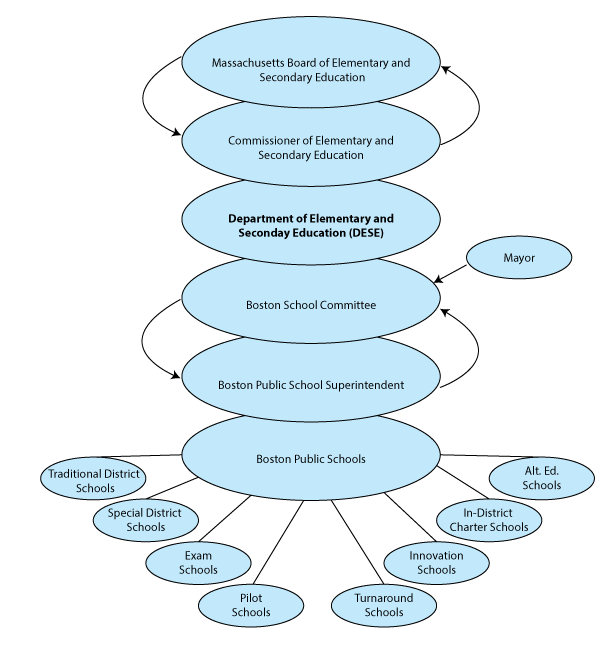
State Education Hierarchy

The Massachusetts Department of Elementary & Secondary Education (DESE) is the organization responsible for public education at the elementary and secondary levels in Massachusetts. DESE is led by the Commissioner of Elementary and Secondary Education who oversees curriculum implementations, accountability and assessment programs, and district analysis. Right now, Mitchell D. Chester is commissioner.

The Massachusetts Board of Elementary and Secondary Education is the governing body in charge of DESE and evaluates the performance of the commissioner.The chair of the board is designated by the governor of Massachusetts, and the commissioner is a member of the board.

The Boston School Committee is the governing body of the Boston Public Schools (BPS). The school committee is responsible for defining the vision, mission and goals of BPS; establishing and monitoring the annual operating budget; hiring, managing, and evaluating the superintendent; and setting and reviewing district policies and practices to support student achievement. The seven members of the school committee are Boston residents appointed by the mayor of Boston to serve four-year staggered terms.

The Boston Public Schools superintendent oversees policy, administrative issues, curriculum standards and school department management for BPS. The superintendent is hired by the Boston School Committee.

There are 128 schools in the Boston Public Schools:

  • Some are traditional district schools or special district schools.
  • Exam schools are schools that allow admission based on students' scores on national entrance exams plus grade point average. In Boston these are Boston Latin Academy, Boston Latin School, and O'Bryant School of Math and Science.
  • Part of the school district but have autonomy over budget, hiring, governance, curriculum, and school calendar, pilot schools were created to be models of educational innovation. They often serve as research and development sites for effective urban public schools.
  • Turnaround schools are selected by the district for increased support based on designation as an under-performing school.
  • While most are bound by the district's teachers union contract, decisions surrounding staffing, curriculum, and budgeting at innovation schools are made by a school-based governing board. Each school must negotiate the extent of the freedom to make its own decisions with the superintendent and school committee.
  • In-district charter schools are semi-autonomous schools that are approved by both the Boston School Committee and DESE. They are funded by BPS.
  • Alternative education schools have programs which may serve students who are new to the U.S., are over-age or off-track, need to go to school at night, have disabilities, or disciplinary issues.

Related coverage

Reporter's Notebook

New Independent Charter Schools Unlikely This Year

Update on October 17, 2014: Charter School Applicants Seek State Waiver

The groups seeking to open charter schools in Brockton and Fitchburg have requested the state education commission reverse their ruling that stopped their applications from moving forward.

The schools were told they could not proceed in the application process because of a state law that requires school districts that apply for independent charter funding to be in the lowest 10th percentile of MCAS scores in the state.

Our original post continues:

Massachusetts probably won't approve any new independently run charter schools this year.

Two new charter school applications, in Brockton and Fitchburg, were halted last week after state officials uncovered a procedural error that allowed the schools to advance in the approval process, the Boston Globe reported.

Read more of New Independent Charter Schools Unlikely This Year →

Last Bell

Brooke Clenchy Named Senior Associate Commissioner at DESE

Brooke Clenchy was named Friday as Massachusets' new associate commissioner of education. In this role Clenchy will oversee the state's K-12 curriculum and instruction.

Outgoing associate commissioner Bob Bickerton retired this year after 26 years at the Department of Elementary and Secondary Education.

A press release from DESE is after the jump.

Read more of Brooke Clenchy Named Senior Associate Commissioner at DESE →

Reporter's Notebook

Data Challenge Invites Hackers to Help Enhance Education Policies

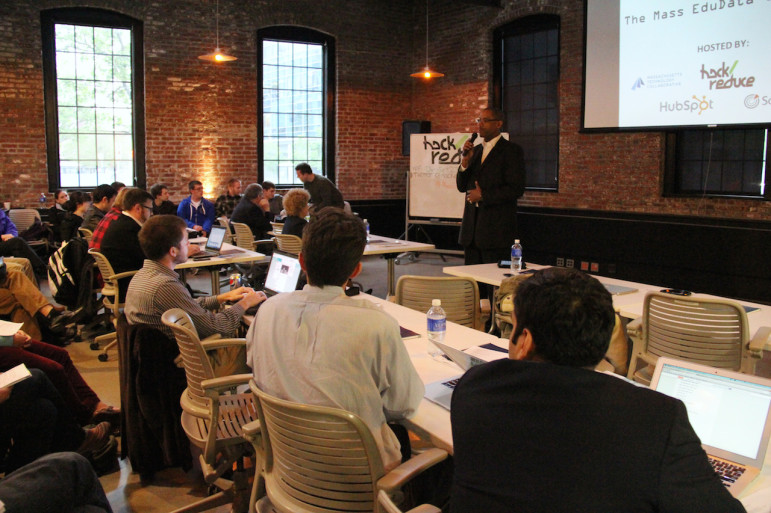
More than 60 civic hackers, developers, and students have spent the past month poring over troves of Massachusetts school data as part of the six-week Mass EduData Challenge hackathon. Their goal: to create tools to analyze and find education trends.

The data, provided by the Massachusetts Department of Elementary and Secondary Education (DESE), dates back to 1995 and spans 351 cities and towns. Competitors are tasked with analyzing the education data, identifying relationships with external data sets, and providing insights in a user-friendly manner.

Participants may -- or may not -- have a background in education.

"I was really interested in seeing how the education system here in Massachusetts works," said David Lago, an application architect participating in the challenge. "I was interested if there was any way that we could make the information more accessible for people."

Read more of Data Challenge Invites Hackers to Help Enhance Education Policies →

Reporter's Notebook

Study: Equalizing Funding Helped Poor Students

From 1971 to 2010, courts in 28 states mandated reforms aimed at equalizing funding across districts, instead of simply relying on local property taxes. A working paper from the National Bureau of Economic Research, a Cambridge-based think tank, finds that increasing funding to previously disadvantage school districts helped poor students close the gap with their…

Read more of Study: Equalizing Funding Helped Poor Students →

Reporter's Notebook

Business Community Calls for New Era of Ed Reform

A coalition of Massachusetts business leaders, worried that local schools aren't doing what it takes to educate the future workforce the state needs, on Monday called for a broad series of education reforms ranging from classroom initiatives to full system-wide reform.

Promising a legislative push, business leaders warned that Massachusetts students risk falling behind and that they already are not meeting employers expectations as they enter the workforce.

"Not everyone is saying we need to change everything," Steve Koczela, president of MassINC Polling Group, said. "A lot of people are saying we need to change something."

Read more of Business Community Calls for New Era of Ed Reform →