Learning Lab
This is an archive of WBUR’s Learning Lab, which covered education in Massachusetts from 2013 to 2016.

Explainer

PARCC, MCAS and the Future of Standardized Testing in Massachusetts

What is PARCC?

The Partnership for Assessment of Readiness for College and Careers (PARCC) is a new computer-based test that will measure students' abilities according to the Common Core standards in math and English.

There will be two sets of tests for each of the subjects, one with long-form answers in March and another with short answers near the end of the school year. There will also be tests of listening and speaking skills.

PARCC is set to replace the current MCAS math and English exams for students in grades 3 through 11.

What is MCAS?

The Massachusetts Comprehensive Assessment System (MCAS) are a set of exams used to assess Massachusetts' statewide education standards. All students in grades 3-8 and 10 at schools that receive state funding must take the exam each year.

Under the current setup, students must pass the 10th grade MCAS in English language arts (ELA), math, and a science subject in order to graduate.
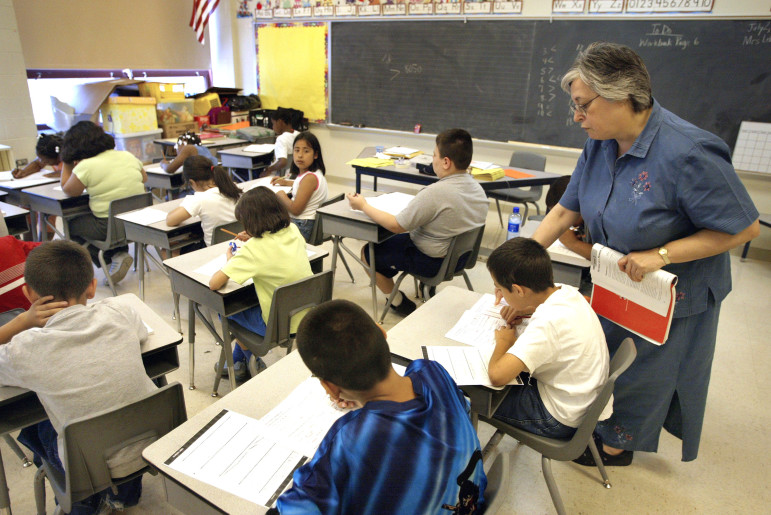
(Tim Boyle / Getty Images)

PARCC timeline

The transition will happen slowly, but surely. At least through the class of 2017, the current MCAS high school graduation requirements can remain in place. Until then, individual districts may choose whether they want to use PARCC or MCAS exams. Many have already switched over to PARCC.

The state board of education will wait until 2015 to decide whether to adopt the PARCC test for 3rd through 8th grade students throughout the state. The board may wait that long or longer to decide whether PARCC will replace the 10th grade MCAS tests.

PARCC vs. MCAS: Advantages And Disadvantages

A point of contention is the platform of the tests. The goal is to have all students eventually take the exam on a tablet, laptop, desktop or other type of computer device.

Supporters argue this will enhance tracking student progress and that the test is adapting to the 21st century. Others argue that students in poorer districts may not have as much practice or access to computers. They say a technological divide may be confused as an achievement gap.

Districts will need to provide their own computer systems to administer the test.

Timing is another key difference. On MCAS, students can take as much time as they need. PARCC exams will have time limits.

There is no PARCC test in science, so the MCAS is expected to continue in that subject. To recieve a diploma, students currently have to pass all three subjects.

Cost

In 2013, school officials figured it will cost $29.50 per student to test English and math using the PARCC. The MCAS costs $46 per student to test the same two subjects.

(Kentucky Country Day / Flickr)

So, Why The Controversy?

The implementation of PARCC exams marks the switch to Common Core standards in the state. With new standards, new ways of evaluating them are needed. The large-scale standards change is not one that was expected to transition completely smoothly, and, unsurprisingly, it has not.

Common Core is not just unique to Massachusetts -- it is being implemented in 43 states across the country. Fifteen states will use PARCC exams to evaluate students. Fears are present about Massachusetts losing local control of testing. The state currently tops state education rankings.

Massachusetts is a testing ground to measure the effectiveness of the test for other states. Parents have claimed they don't want their children being used, as some have said, "as lab rats."

Additionally, the tests will be long and there will be a lot of them.

Where MCAS exams were administered once yearly, PARCC will have two sets of tests for each of the subjects. One test with long-form answers in March and another with short answers near the end of the school year.

PARCC estimates the exams may take eight hours for the average third-grader and almost 10 hours for highs school students.

With more time and more tests, that means more money for testing companies. According to Politico, Pearson, the company who won the bid to deliver PARCC tests, could earn more than $1 billion over the next eight years if enough states adopt the test. Many, including Peabody School Committee member Dave McGeney, see the adoption of the new standards and tests as part of a larger "educational industrial complex."


More

Related coverage

Reporter's Notebook

Amid Concerns, Baker Says Chester Belongs 'In The Conversation' On PARCC

Gov. Charlie Baker said Tuesday he doesn't see a need for Education Commissioner Mitchell Chester to recuse himself from the decision on whether to replace the MCAS standardized test with the new PARCC exams.

Chester has been criticized for chairing the governing board of the group that developed the PARCC exams while leading the Massachusetts Department of Elementary and Secondary Education. The latest call for him to step out of the decision came Tuesday from the Boston-based Pioneer Institute, a free-market-focused think tank.

Baker, however, said he doesn't think Chester's position "renders him unable to participate in the conversation," in part because the decision, expected this fall, would ultimately be up to the Board of Elementary and Secondary Education (BESE). Chester's role is to make a recommendation to the board.

Read more of Amid Concerns, Baker Says Chester Belongs 'In The Conversation' On PARCC →

Reporter's Notebook

State To Hold Public Forums On PARCC, MCAS Tests

The Board of Elementary and Secondary Education wants feedback about which standardized achievement assessment the state should adopt.

Beginning this week, the public has the opportunity to let state education officials know whether they think the state should continue to use Massachusetts Comprehensive Assessment System (MCAS) or adopt the new Partnership for Assessment of Readiness for College and Careers (PARCC).

It is also an opportunity for the public to express their opinions of high-stakes standardized testing, in general.

Read more of State To Hold Public Forums On PARCC, MCAS Tests →

A good school is ...

Civil Rights Groups Call For A Better Measure Of Accountability In Public Education

The country's current education system is placing "tremendous burden on schools disproportionately serving low-income students and students of color" and leaving them under-resourced and ill-prepared, charged a coalition of civil rights groups in a letter to President Barack Obama, Education Secretary Arne Duncan, congressional and state educational leaders.

Eleven civil rights groups released the letter Tuesday urging improved accountability at the local, state, and federal levels in order to increase equity and opportunity for students of color. The group wants to see government officials implement measures beyond high-stakes testing to make sure schools are serving students well.

Read more of Civil Rights Groups Call For A Better Measure Of Accountability In Public Education →

Reporter's Notebook

MCAS Vs. PARCC: What's The Difference?

At one point, all of Massachusetts schools used Massachusetts Comprehensive Assessment System (MCAS) exams to measure student performance. Now, over half of the state's school districts have switched over to a new standardized test -- the Partnership for Assessment of Readiness for College and Careers (PARCC) exam.

Some parents, educators, and students may be scratching their head: What, exactly, is the difference?

Read more of MCAS Vs. PARCC: What's The Difference? →

Reporter's Notebook

Boston Schools Will Switch To PARCC Exam

The Boston School Committee voted Wednesday night to switch to a new computer-based standardized testing system beginning next spring.

The new PARCC exam, short for the Partnership for Assessment of Readiness for College and Careers, has been controversial among teachers and parents. Unlike the exam it replaces, PARCC is entirely computer-based. The new test is also tied to Common Core standards, a project aimed at aligning state education standards across the country.

On the recommendation of Interim Boston Public Schools Superintendent John McDonough, all four of the six School Committee members present voted to switch from MCAS to PARCC.

Read more of Boston Schools Will Switch To PARCC Exam →

Reporter's Notebook

School Committee Roundup: Lincoln-Sudbury Stick With MCAS, Concord Holds Coffee Session, Wellesley MCAS Review

The Lincoln-Sudbury School Committee gave a resounding "no" to replacing the districts existing standardized tests, MCAS exams, with PARCC exams -- the exams that are slated to eventually replace MCAS exams statewide, reports the Sudbury Town Crier. The Lincoln-Sudbury school board Tuesday night emphatically declined a chance to offer the PARCC to students next spring,…

Read more of School Committee Roundup: Lincoln-Sudbury Stick With MCAS, Concord Holds Coffee Session, Wellesley MCAS Review →

Reporter's Notebook

88 Percent Of Mass Students Pass MCAS; See Scores By District

Friday saw the release of MCAS scores across the state -- and 88 percent of sophomore students passed. The number of passing students remains unchanged from last year, but an improvement from 86 percent in 2012.

State education officials say 88 percent of high school sophomores passed the standardized MCAS exam on their first try this year, the same as last year, and that while achievement gaps persist statewide, they are narrowing.

Read more of 88 Percent Of Mass Students Pass MCAS; See Scores By District →