The use of exclusionary school discipline -- out-of-school suspension, expulsion, referral to law enforcement or school-related arrest -- can have lasting effects that push students toward the criminal justice system later in life, a process that has been termed the "school-to-prison pipeline."
Here is the "school-to-prison pipeline" explained, and its impact in Massachusetts schools.
What is the school-to-prison pipeline?
Simply put, data shows that zero-tolerance policies and repeated school discipline can push students out of school and lead to repeated arrest and incarceration.
Here it is, by the numbers:
Children who have been expelled or suspended from school once are much more likely to be disciplined similarly again, and twice as likely than their peers to drop out, according to a study by the Civil Rights Project at UCLA. Students who are arrested at school are three times more likely to drop out than their peers.
Students who drop out of school are then eight times more likely to end up in the criminal justice system than students who graduate. A study of Massachusetts felons found that offenders who had at least one juvenile arraignment were more likely to be re-convicted of a crime within 3 years of being released from prison.
School environments with zero-tolerance policies -- strict disciplinary codes for any student who breaks the rules -- can have long-term impacts that, advocates say, set students on a path that can end behind bars.
Who is affected?
Students of color and students with disabilities absorb a disproportional impact of school discipline policies.
Black students in Massachusetts schools are almost four times more likely than white peers to be suspended from school and Latino students are 3 times more likely than white students to be suspended -- often for minor offenses, according to a 2014 study.
Students of color are more likely to be disciplined for subjective offenses, such as defiance, disrespect or dress code violations, according to Matt Cregor, co-author of a report on Massachusetts school discipline. White students, on the other hand, are more likely be punished for documented offenses like alcohol possession, smoking or vandalism.
Schools with more black students tend to have higher rates of suspension, in general. A 2010 study by researchers at Villanova University showed that nationally, the severity of a school's discipline policy was positively correlated with the percentage of students that were black, not juvenile delinquency or drug use.
In Massachusetts, during the 2012-2013 school year, black students received 43 percent of all out-of-school suspensions and 39 percent of expulsions, despite making up less than 9 percent of students enrolled.
Nationally, discipline differences across race lines for students with disabilities are vast: 1 in 4 black children with disabilities are suspended, compared to 1 in 11 white students.
School discipline and educational disparities mirror a stark reality of the criminal justice system: only 7 percent of Massachusetts residents are black, yet 28 percent of the people behind bars in Massachusetts are black.
How did we get here?
Many policies and practices can be pointed toward to explain why students of color and students with disabilities disproportionately absorb the impacts of school discipline.
According to the American Civil Liberties Union (ACLU), "second-rate" educational environments -- schools with overcrowded classrooms, a lack of qualified teachers, insufficient funding for services -- can be a beginning. Failure to meet educational needs increases disengagement and at-risk behavior.
Other primary factors include the adoption of zero-tolerance discipline policies and the presence of law enforcement in schools.
Vox provides some national context:
The Gun-Free Schools Act, passed in 1994, mandated a yearlong out-of-school suspension for any student caught bringing a weapon to school. And as states began adopting these zero-tolerance policies, the number of suspensions and expulsions increased. The suspension rate for all students has nearly doubled since the 1970s, and has increased even more for black and Hispanic students.
Zero-tolerance policies have been widely criticized when schools have interpreted "weapon" very broadly, expelling students for making guns with their fingers or chewing a Pop-Tart into a gun shape or bringing a camping fork for Cub Scouts to class.
But they're not the only reason schools suspended students more frequently. At the same time as zero-tolerance policies for violence were growing, school districts adopted their own version of the broken windows theory of policing. The broken windows theory emphasizes the importance of cracking down on small offenses in order to make residents feel safer and discourage more serious crimes; in schools, it translated into more suspensions for offenses that previously hadn't warranted them — talking back to teachers, skipping class, or being otherwise disobedient or disruptive.
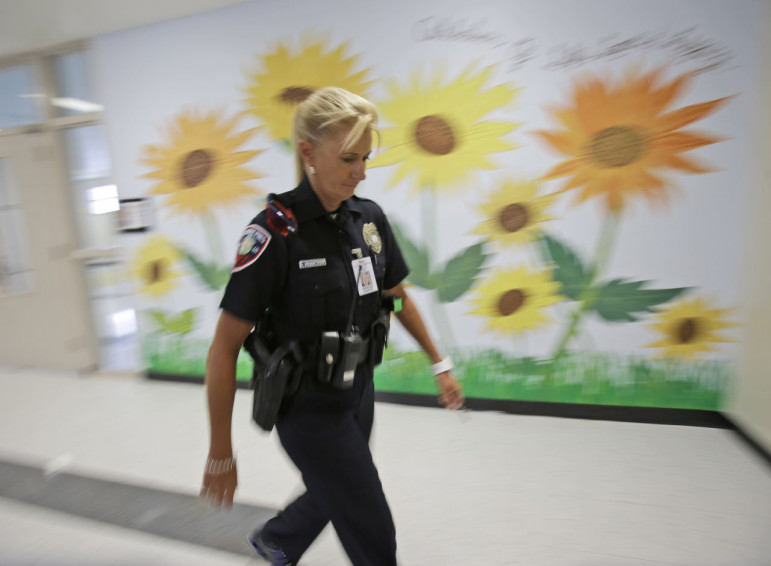
As policies for student conduct became more strict, school districts also began to station actual police officers in schools.
From 1997 to 2007, the amount of law enforcement stationed in schools increased by more than a third nationally. According to the National Association of School Resource Officers, school-based policing is presently "the fastest growing area of law enforcement."
In 2008, Boston Public Schools had the 12th largest number of full-time law enforcement personnel of any school district in the country.
An ACLU report of school policing in Massachusetts' three largest school districts -- Boston, Springfield, and Worcester (all predominantly low-income districts with majority students of color) -- found "numerous arrests at school during the school day based on misbehavior that could have been addressed more appropriately by teachers and school staff, and with significantly less harm to students."
The report found that in Springfield, most public order arrests involved youth who refused to obey directives in a "verbally confrontational manner."
This means students who swore or exhibited other disrespectful behavior towards teachers, police officers or other adults were arrested and charged with a crimes such as "disorderly conduct," "disturbing a lawful assembly," or "violating codes of conduct."
An example from Springfield:
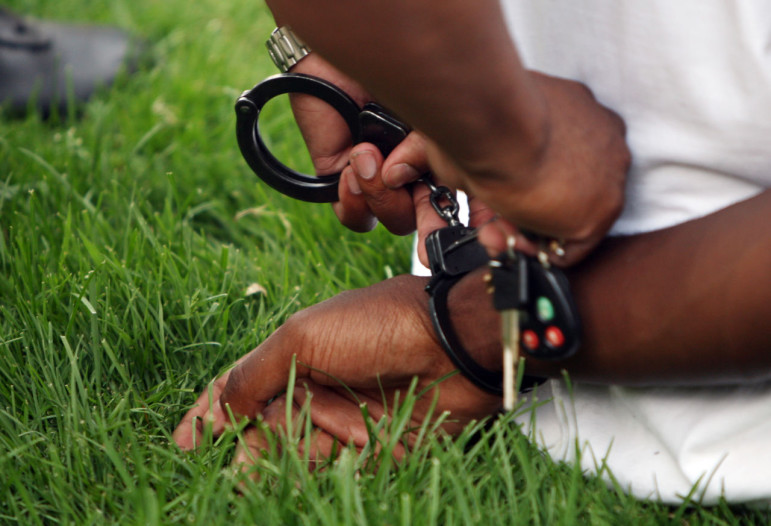
In 2007, a boy at Kennedy Middle School was found with a cell phone in his book bag in violation of school policy. School administrators confiscated the phone and told the student that his mother would have to come to the school to retrieve it. The student then started “walking around the office” and stated that he needed his “f-cking phone.” The student was warned that he was becoming disruptive, but continued to swear and state that he needed his phone. He was advised that he was going to be arrested, stated that he did not care, and was then handcuffed and told to sit down. He was charged with disturbing a lawful assembly.
The report concluded that policing practices disproportionately affect the same two groups of students most influenced by school discipline: students of color and students with behavioral or learning disabilities.
How could high-stakes testing be a part of it?
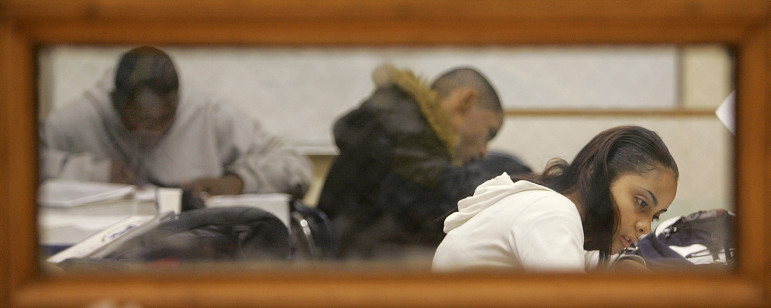
With the adoption of the federal No Child Left Behind standards in 2002, states were required to develop assessments to test skills in reading, math and science. In Massachusetts students must pass 10th grade standardized assessments in order to graduate. Teacher evaluations are often tied to student test scores.
Due to the high-stakes consequences attached to testing, some say a shift in school cultures has appeared.
A four-year investigation into whether school discipline could be used to reshape testing pools in Florida public schools, found that during testing periods low-performing students often received substantially harsher suspensions than high-performing peers for similar offences.
What is being done about it?
Civil rights advocates, parents, policy makers and school officials have turned an eye toward addressing the disproportionate effects of school discipline.
In August 2012, Massachusetts passed a law, commonly referred to as Chapter 222, to prevent the unnecessary exclusion of students from school.
In response, districts have developed updated codes of conduct aligned to Chapter 222 rules. Boston's code of conduct, for example, requires progressive measures of discipline before suspension. In the result of a suspension or expulsion, the district must provide continued educational services.
Individual schools and districts have turned toward restorative justice measures, which are designed to enfranchise youth, instead of zero-tolerance policies and suspensions.
Restorative justice measures include written apologies, conferences between offenders and victims, anger management courses, or enrollment in intervention and prevention programs.
While the law and restorative justice techniques have led to a reduction in discipline practices statewide, students of color and students with disabilities still remain disproportionately affected.