Learning Lab
This is an archive of WBUR’s Learning Lab, which covered education in Massachusetts from 2013 to 2016.

Explainer

How School Funding Works In Massachusetts

K-12 schools in Massachusetts receive a combination of state and local funding according to a formula in Chapter 70 of the state code.

MassBudget has a good explainer on Chapter 70, as well as a more general report on school funding.

The short version: The state determines a base level of per-pupil funding each district needs, as well as how much a district ought to be able to fund from local taxes. The state then makes up any gap in funding. This base funding level is called the "foundation budget."

The foundation budget is a floor, not a ceiling, however. Districts can raise more money locally with no penalty.

Here's an example, courtesy of MassBudget:
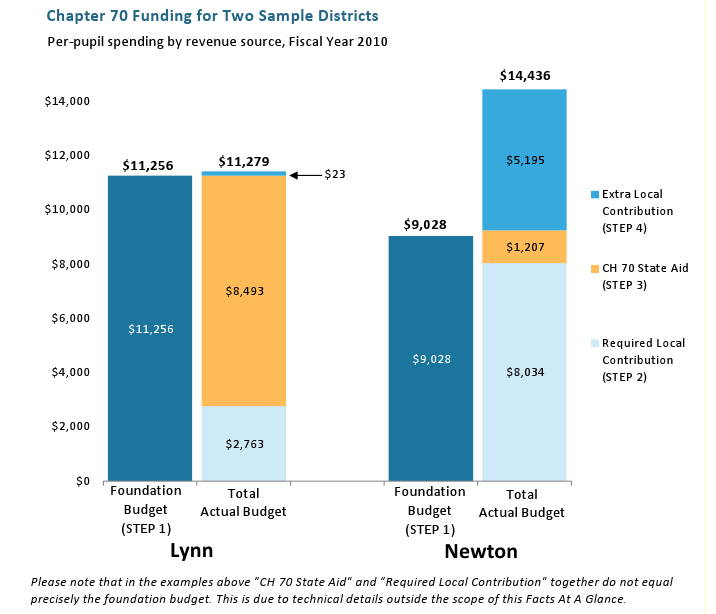
Demystifying the Chapter 70 Formula
(MassBudget)

The state estimates that Lynn's student population needs more money (and therefore has a higher foundation budget), yet Newton spends more per pupil because its residents are willing and able to pay higher taxes. In other words, the state spends more on students in Lynn, but Newton schools spend more (per-student) overall.

Related coverage

Reporter's Notebook

Guest Column: 'Keep A Clear Head About The School Deficit'

At Wednesday night's Boston School Committee meeting, Interim Superintendent John McDonough proposed to close a handful of Boston schools, citing a deficit of $42 million to $52 million in the Boston Public Schools budget.

Liam Kerr is the Executive Director of the political advocacy group Democrats for Education Reform. He says when people wonder "where did the money go?" they should keep a few things in mind.

 
Silly season is about to start here in Boston when it comes to public school finances.

The annual municipal budget process puts our investment priorities under an annual review, providing an ideal opportunity for special interests and aggrieved parties to make noise. This noise is loudest on the Boston Public Schools budget, and for good reason. Education counts for more than a third of the city budget, not to mention thousands of hopes, dreams, values, and paychecks.

Read more of Guest Column: 'Keep A Clear Head About The School Deficit' →

Reporter's Notebook

Commission To Review Whether Mass. School Districts Get Enough Funding

Could we be working with an outdated, ineffective and, ultimately, wrong method of calculating the amount of money school districts need?

Some Massachusetts policy analysts think so. Now, the state Legislature has a group working to officially answer that question.

The Foundation Budget Review Commission, created by the Massachusetts Legislature last year, will examine the school finance law that determines how much money Massachusetts' local and regional school districts need in order to provide students with an adequate education.

Read more of Commission To Review Whether Mass. School Districts Get Enough Funding →

School Committee Roundup

School Committee Roundup: Palmer Budget, Lynn Superindent Evaluation, Community Day Charter Renewal

Palmer Public School Committee member David Lynch noted that the school committee raised concerns over a lack of funding for education coming from the state. The cost of special education requirements in particular were discussed. The district, Lynch said, is aiming to reduce the number of students sent to outside districts in order to receive…

Read more of School Committee Roundup: Palmer Budget, Lynn Superindent Evaluation, Community Day Charter Renewal →

Reporter's Notebook

Education Committee Chair Sonia Chang-Diaz Suggests Quadrupling Funding for Alternative Education

Massachusetts Senator Sonia Chang-Diaz (D-Jamaica Plain) suggested Tuesday that the state quadruple its financial support for alternative education programs.

The state spends just $150,000 a year on alternative education programs for at-risk students, a 90 percent decrease from its peak in 2006.

"If we were to quadrupule the line item, it would still be small, but think of what we could do to fund effective programs and fight the good fight," she said.

Chang-Diaz spoke Tuesday at the release of a new report on alternative education by the Rennie Center. The report encourages policymakers to redefine, strengthen and expand alternative education programs throughout Massachusetts, saying that not only does demand outpace need in alternative education, but that existing models provide models for wider education reform, even in traditional schools.

Read more of Education Committee Chair Sonia Chang-Diaz Suggests Quadrupling Funding for Alternative Education →

Reporter's Notebook

Study: Equalizing Funding Helped Poor Students

From 1971 to 2010, courts in 28 states mandated reforms aimed at equalizing funding across districts, instead of simply relying on local property taxes. A working paper from the National Bureau of Economic Research, a Cambridge-based think tank, finds that increasing funding to previously disadvantage school districts helped poor students close the gap with their…

Read more of Study: Equalizing Funding Helped Poor Students →

Reporter's Notebook

Last Bell: Funding Conflict Between Charter and Public Schools, Democrats and Teachers Unions, and Where Bill Gates is Spending his Money

There is a problematic funding conflict between charter schools and traditional public schools, Clive McFarlane writes in the Worcester Telegram & Gazette. He calls charter schools a "second public school system" and says they "are funded by pulling money from the budget of the school districts from which the charter schools enroll students." The more…

Read more of Last Bell: Funding Conflict Between Charter and Public Schools, Democrats and Teachers Unions, and Where Bill Gates is Spending his Money →

Last Bell

Last Bell: Charlie Baker on Early Education, Malden Student a finalist in Google Doodle Competition, Testing Here and Abroad, and Charter School Funding

Republican gubernatorial candidate Charlie Baker briefly discussed education with The Berkshire Eagle this week, saying advancements in early education are meaningless without strong upper-level public schools. The Eagle quotes Baker as saying: "If we're going to be strategic about how we approach the early childhood ed piece, we've got to make sure that the kids…

Read more of Last Bell: Charlie Baker on Early Education, Malden Student a finalist in Google Doodle Competition, Testing Here and Abroad, and Charter School Funding →

Reporter's Notebook

The Big Question About Schools And Budgets

As state legislators debated the education section of next year's budget in the House chambers overhead, Massachusetts Sen. Sonia Chang-Diaz sat in a basement auditorium Tuesday at the State House with local school committee members and fielded what she believed were several versions of the same question.

"How do we pay for the things that we know are going to work in education?"

Members of the Massachusetts Association of School Committees gathered Tuesday for their annual "Day on the Hill," a chance for representatives from towns across the Commonwealth to discuss issues in public education with state policymakers.

Read more of The Big Question About Schools And Budgets →