Learning Lab
This is an archive of WBUR’s Learning Lab, which covered education in Massachusetts from 2013 to 2016.

August 2015

Reporter's Notebook

Massachusetts Students Tie For Top Score On ACT

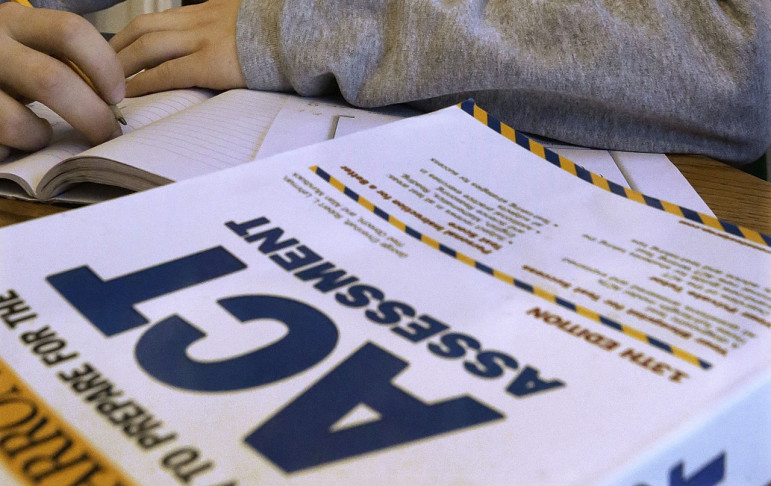
Massachusetts high school seniors tied this year for the nation's highest average score on the ACT, a standardized test akin to the SAT that measures college and career readiness.

The average score for public and private school graduates in Massachusetts and Connecticut was 24.4 out of 36, the highest in the nation and more than three points higher than the national average. The results were released Wednesday by the ACT.

"I congratulate our Commonwealth's students, who continue to lead the country in academic achievement and college readiness," said Governor Charlie Baker in a statement.

Just over half of Massachusetts students met all four ACT College Readiness Benchmarks, well above the national average of 28 percent. The benchmarks represent the level of achievement for students in English, math, reading and science.

Read more of Massachusetts Students Tie For Top Score On ACT →

Reporter's Notebook

Why Does School Start In September? Hint: It's Not The Crops

Kids in Boston and many other local districts go back to school the day after Labor Day. Others are already there. Either way, school always starts around now, and it always has, because kids had to spend the summer at work on the farm, right?

Not exactly.

"The agrarian model that dominated our educational landscape looked very different from what we have now," says Kenneth Gold, dean of education at the College of Staten Island. "That's just the prevailing myth."

In fact, the familiar September-to-June school year has almost nothing to do with farm kids.

Read more of Why Does School Start In September? Hint: It's Not The Crops →

Reporter's Notebook

Most Unassigned Boston Students Are In Pre-K, Chang Says

BOSTON -- Universal pre-kindergarten in Boston Public Schools is still a goal, but it won't be happening this school year.

School officials say more than 1,800 3- and 4-year-olds have been placed on wait lists for pre-kindergarten because the city does not have any more open spaces. The city added 100 pre-K seats this year, bringing the total to 2,400, but still fell short.

“What this really tells us is there is a great demand for pre-K seats here in Boston,” said Boston School Superintendent Tommy Chang, “and we cannot fulfill that need because we don't have the space and we don't have the funding yet at this point.”

Chang said he and Mayor Marty Walsh recognize how essential early education is to students' long-term success.

“As we all know, the mayor and myself are very committed over the long term to make sure that there is a quality pre-K seat for any student that wants it,” Chang said. “I think this calls all of us into some action. We know that as early as we can provide education, formal education, to our youngest kids, it's going to be best for them long term. The research is very clear about that.”

But he said he doesn’t know how long it will take to find the money to make pre-K available to everyone who wants it.

“If there were guaranteed seats and we could find seats in neighborhoods for all parents, that's what we would do,” he said. “A lot of this is a funding issue.”

In response to news reports that more than 8,000 BPS students were still awaiting assignments, Chang said that most of the unassigned students were pre-kindergarten 3- and 4-year-olds.

Read more of Most Unassigned Boston Students Are In Pre-K, Chang Says →

Reporter's Notebook

Mass. Schools Get $14 Million To Extend Learning Time

BOSTON -- Schools in 11 Massachusetts school districts will receive $14 million in state grants to extend the time of the school day this year.

"Too often, our school year is insufficient to provide a strong, high-quality education," Mitchell Chester, commissioner of elementary and secondary education, said in a statement. "I am pleased to see schools take advantage of this opportunity to strengthen their programs for both students and teachers."

The grants will pay for at least 300 hours of additional learning time in each school. That time may be filled with more classroom instruction, enrichment opportunities for students, additional professional development for educators or a combination of these activities.

Read more of Mass. Schools Get $14 Million To Extend Learning Time →

Reporter's Notebook

In Sailboats And Science Classes, Student Learning Continues During Summer

BOSTON -- Though a sailboat may be bigger than their parents' cars, young captains Valerie Geraldo and Wendy Santamaria operate the vessel with ease. They harness the wind and sail their 19-foot boat through Boston Harbor.

"I've been learning how to sail and how to pull the jib when we need to go to another direction," says Geraldo, a soon-to-be fourth grade student. "When you steer you need to go to the opposite side."

"My favorite part about sailing is that it helps you get your strength up," adds Santamaria, a soon-to-be fifth grade student. "Because you have to pull the mainsail and the jib -- and it's really heavy."

Geraldo and Santamaria are members of Courageous Sailing's "Swim, Sail, Science!" summer program run out of the Charlestown Navy Yard. The program, for soon-to-be fourth- and fifth-grade Boston students, has been operating since 2012 to give low-income youth lessons in swimming, sailing and science -- all at no cost to their families.

Read more of In Sailboats And Science Classes, Student Learning Continues During Summer →