Learning Lab
This is an archive of WBUR’s Learning Lab, which covered education in Massachusetts from 2013 to 2016.

March 2016

Reporter's Notebook

Mass. Senate Unveils New Charter School Bill Tying Cap To State School Funding

By Steve Brown

With a ballot question aimed at raising the cap on publicly funded charter schools looming this fall, the state Senate has unveiled a bill that would not only raise the cap, but also seeks to address funding concerns for traditional district schools.

The senators who drafted the proposal say it not only increases the cap on charter schools, but also puts district schools and charter schools on a level playing field. They say the proposed ballot question addresses the needs of less than 10 percent of the state's public school children.

In announcing the plan, Senate President Stan Rosenberg said the Senate is looking beyond just charter schools.

"What we were seeking to accomplish through this exercise was to step back and do what we would call a 20-year review and revise exercise based upon the work that was done to provide choice in education, to create excellence in education here in the commonwealth of Massachusetts, which started in 1993 with the education reform act of that year," Rosenberg said.

Read more of Mass. Senate Unveils New Charter School Bill Tying Cap To State School Funding →
Reporter's Notebook

Cambridge Rindge And Latin Diversifies -- With Private-School Students

By Sally Jacobs

Levi Herron, a lanky blond eighth-grader, has a difficult choice to make in the next few weeks.

Herron, who has attended private school all his life, needs to decide where he will go to high school in the fall. His father would like him to go to the Pomfret School, a boarding school in Connecticut that he and many family members attended. But Herron likes another school, too: the city’s public high school, the Cambridge Rindge and Latin School. It’s just a few blocks from his home.

“If I had to make the choice today, I think I would definitely choose Rindge,” said Herron, who attends the St. Peter School in Cambridge. “I think it's just a really unique experience that could mean a lot to me throughout my life and really put me on a good path."

Herron is one of an increasing number of independent- and parochial-school students turning to the public high school. Already, 60 private school students have signed up to attend Rindge in fall 2016, more than 13 percent of the average freshman class of 450. That’s up from just five in 2011 and 49 last year.

Administrators and school committee members say that the new students, most of whom are white, add to the school's famously diverse student body, in which more than 70 countries are represented. The school has about 60 percent students of color and 47 percent low-income students; 69 students are homeless.

Private-school students, many of whom are affluent, remain a minority. But Principal Damon Smith says their rising numbers present a challenge.

Read more of Cambridge Rindge And Latin Diversifies -- With Private-School Students →

Reporter's Notebook

What Discipline Looks Like At A Boston School With 325 Suspensions

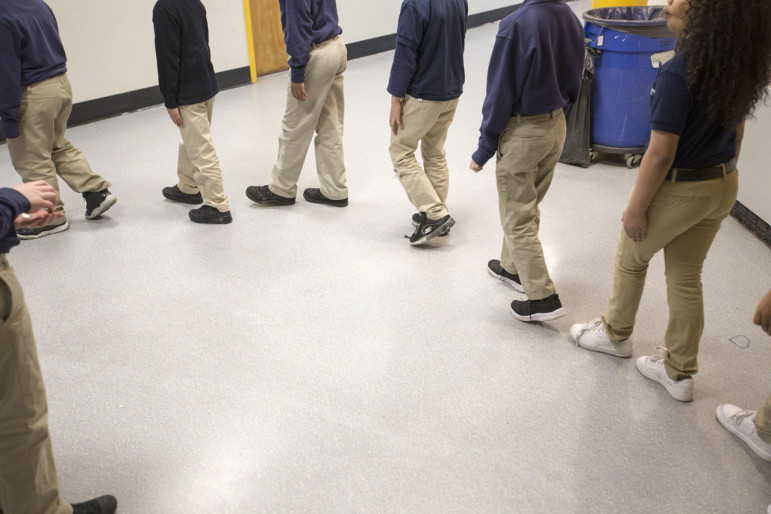
BOSTON -- Second- and third-graders walk in silence through the hallways of UP Academy Holland. A student speaks to his classmate, and a teacher gives a soft but stern warning. UP Academy Holland’s rules are explicit: No talking in the halls.

Teachers walk along with the groups of students. Each teacher clasps a stick striped in rainbow colors, with clothespins bearing the students’ names clipped on from top to bottom. If your clothespin is at the bottom, in the red zone, it means you’ve misbehaved. And everybody knows it.

It’s all part of the “broken windows” theory of discipline at UP Academy Holland, a Dorchester public school that was declared “failing” in 2013. It's now run by a nonprofit network under state supervision.

The theory, borrowed from policing, holds that cracking down on minor offenses will create a culture with fewer major ones. UP Academy Holland embraces that philosophy in the school turnaround plan created by state Education Commissioner Mitchell Chester and UP Education Network CEO Scott Given.

So UP instructs teachers to “sweat the small stuff” and meet every single infraction of the rules with an immediate consequence. Often, this means issuing an “automatic” -- an automatic consequence for rolling your eyes, or wiggling in your seat, or disputing an automatic, on up to fighting and other dangerous acts.

“Structure is important,” says Given. “I think that it helps to create an environment where students can focus on learning.”

Read more of What Discipline Looks Like At A Boston School With 325 Suspensions →

Reporter's Notebook

Boston Public School Students Stage Walkout Over Proposed Budget Cuts

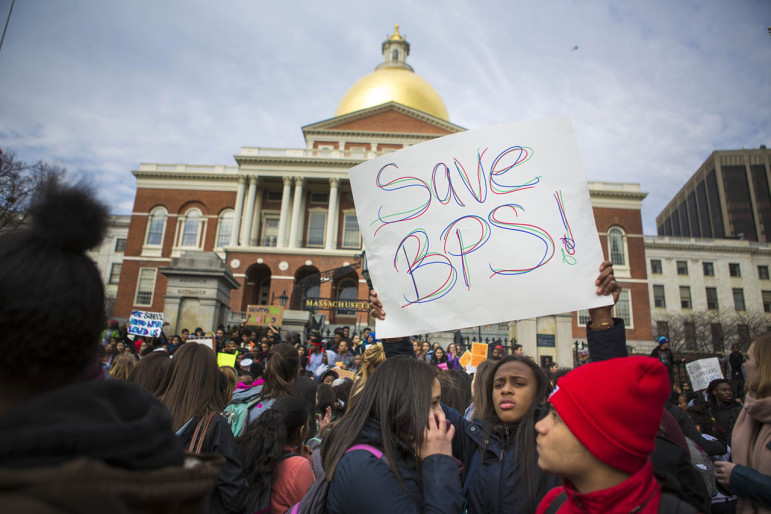
BOSTON -- Hundreds of students across Boston walked out of their classes on Monday to protest proposed districtwide budget cuts.

Boston Public Schools is facing an up to $50 million budget shortfall for the 2016-2017 school year. As a result, individual schools across the district are bracing to lose teaching positions, extracurricular activities, librarians, language programs and music and arts classes.

Jailyn Lopez helped organize Monday's walkout. In a letter circulated on Twitter last week, the Snowden International High School student urged students at all of Boston's public schools to leave class Monday at 11:30 a.m. and march to the State House to rally for more funds for public education.

"No matter what class you're in get up and walk out of school," the letter read. "Let's stand up for our future, if we don't then no one will."

Read more of Boston Public School Students Stage Walkout Over Proposed Budget Cuts →