State education officials Tuesday approved the first new charter school seats in Boston since 2013.
The vote by the state board of elementary and secondary education allows Boston's Edward Brooke and Neighborhood House charter schools to expand to include high school grades.
"I recommended these charters and expansions on the basis of a thorough review, and I appreciate the Board's action," Mitchell Chester, state education commissioner, said in a statement.
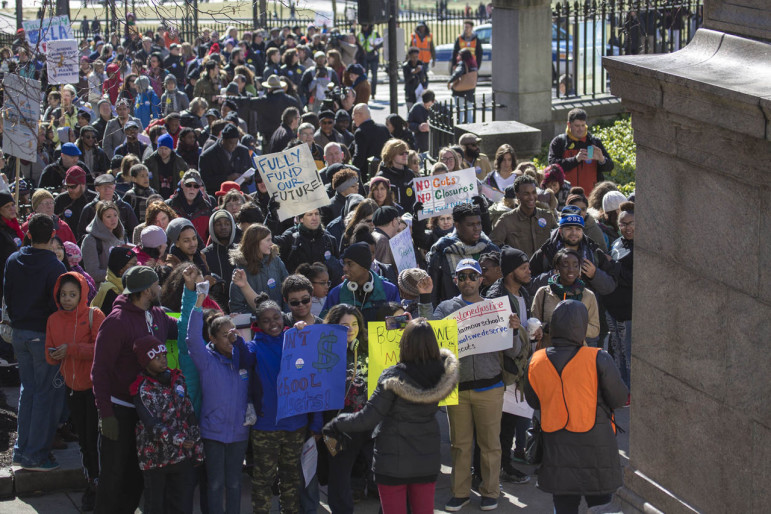
BOSTON -- “Welcome to the movement!” Marleana Rose of the Boston Justice Education Alliance announced to a crowd of more than 200 people gathered outside Boston City Hall for the Boston “Walk-In and Rally for Public Education," one of many held across the country Wednesday.
Students, teachers, parents and community members gathered to protest the proposed Boston Public Schools budget, which could fall short by $50 million. At the proposed level, district schools could lose teachers, after-school programs and elective classes like languages and arts.
Erik Lazo, 16, is a 10th-grader at Snowden International School in Back Bay. One of several students who spoke at the rally, Lazo talked about studying Japanese.
“One of the major reasons I entered that class was to learn that language," Lazo said. "And I eventually met some outstanding friends along the way and had some of the most exceptional and incomparable teachers too.”
But now, he said, if the school has to cut Japanese, his two years of study would be for naught. “Worthless.”
BOSTON -- The state education commissioner will recommend two new charter schools and over 1,500 new seats at existing ones.
Mitchell Chester, commissioner of elementary and secondary education, announced Tuesday that he will advise the state board of education to approve new charter schools in Springfield and Brockton, plus the expansion of five existing charter schools, including four in Boston.
"These two applications and five expansions have undergone a thorough review, and I believe they will provide families with additional high-quality education options," said Chester in a statement. "I appreciate all applicants' interest in serving Massachusetts students."
The state board of education will vote on the recommendation at its Feb. 23 meeting.
The achievement gap between black students and their peers is well documented, but conclusive explanations of the reasons for the gap are harder to come by.
Now a study of more than 15,000 students in Kentucky says that as much as 20 percent of the difference may be due to a single cause: getting suspended from school.
“This analysis -- the first of its kind -- reveals that school suspensions account for approximately one-fifth of black-white differences in school performance,” write sociology professors Edward W. Morris and Brea L. Perry in the study, published in the journal Social Problems last month.
Increases in college costs and concerns about student debt have led to a variety of proposals for free tuition across American higher education.
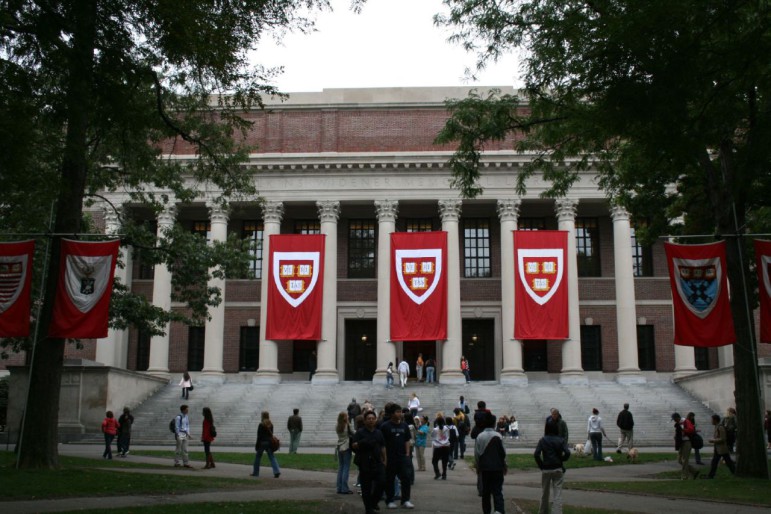
Several alumni hoping to be elected to Harvard University’s Board of Overseers are now campaigning on a platform of zero tuition for Harvard students. Other proposals focus on community college tuitions, which are already relatively low compared to other types of colleges and universities. And U.S. Rep. Tom Reed (R-N.Y.) is going after the country’s selective private colleges with large endowments. His draft legislation would require these schools to increase spending from their endowments in an effort to hold down tuition and reduce student debt burdens.
But who will actually benefit from these proposals?
Reducing tuition at the well-endowed schools would primarily benefit students from the top 20 percent of the income distribution, students and their families who can already pay much or all of the tuition. To help lower- and middle-income students and their families, it makes more sense to focus on expanding need-based financial aid, rather than lowering tuition levels.
BOSTON -- Kindergarten and pre-kindergarten students were suspended 78 times at schools operated by a single nonprofit school management company in the 2014-15 school year, according to state data.
Now, the Boston-based UP Education Network says it will ban suspensions for their youngest students starting Wednesday.
"As a result of an internal evaluation of our practices, UP has decided to no longer issue suspensions to students in kindergarten," Victoria Criado, UP Education Network spokesperson, said by email.
UP Education Network specializes in school turnaround for formerly underperforming schools. Since 2010, the school network has restarted five schools in Boston and Lawrence. Some are in-district charters.
BOSTON -- Massachusetts public and charter schools suspended kindergarten and pre-kindergarten students 603 times in the 2014-15 school year, a WBUR analysis of state data shows.
Students in their first year of school were sent home for offenses that included hitting, disrupting, disrespecting, throwing things and fighting.
Dolores Michel's son Dashon got one of those 603 punishments. He was suspended from school before he could read, write or tie his shoes.
"Oh, the first time was incredible ... that was early last year," Michel says. "They call me and tell me that my son had done this and done that and you need to come and pick him up right away. And I'm saying, 'What did he do?'"
When Michel got to her son's school in Dorchester, she found out. After Dashon got off the bus, he pushed to the front of a line. He wanted to be the first student in class.
"The teacher didn't want him to cut in front of the other student, so the teacher [had] him wait outside," Michel says.
Constant stress hurts learning. Especially when it's stress from the fear that your actions could confirm a stereotype about your race, class or gender.
Think, for example, about a black student sitting in a mostly white physics class, whose teacher seems surprised when he answers a difficult question correctly. The student may then fear that the teacher or other students consider black students less capable -- and that any mistake he makes could confirm that stereotype.
Or the Asian student who fears that answering too many math questions correctly would pigeonhole her into a stereotype. Or the female student who's scared to make a mistake in a science lab full of men. You get the picture.
Stereotype threat -- the fear that one's actions could confirm a negative stereotype -- takes up mental energy that could otherwise be devoted to learning. So it's a no-brainer that removing stereotype threat, and the associated stress, might improve school performance.
Well, it turns out, it does. But not just for the students who feel it most.