Learning Lab
This is an archive of WBUR’s Learning Lab, which covered education in Massachusetts from 2013 to 2016.

December 2015

Reporter's Notebook

MCAS 2.0, Tommy Chang And Other 2015 Education News

Education is always a hot topic in Massachusetts, but this year it seemed to be on fire. Here are a few of the hot spots -- and perhaps the hottest is standardized testing.

By last school year, more than half of Massachusetts school districts had piloted a new standardized test called PARCC. These took the place of the MCAS tests given in Massachusetts schools since 1998. PARCC is more closely aligned to Common Core standards and can be given on computers.

Over the year, teachers and administrators provided feedback on PARCC, and multiple studies were done to study the new test’s effects.

It all laid the groundwork for the Board of Elementary and Secondary Education’s November vote on whether the state should adopt a new standardized test. Teachers, parents, students, policymakers -- everyone seemed to have a pro-MCAS or pro-PARCC stance.

But much of the controversy surrounded one figure: Mitchell Chester, Massachusetts commissioner of elementary and secondary education.

Read more of MCAS 2.0, Tommy Chang And Other 2015 Education News →

Reporter's Notebook

Maybe High Schools Should Start Later -- But How?

It's one of parenting's great mysteries. How can that bright-eyed grade-schooler, bouncing out of bed at 6 a.m., morph into a groggy, irritable teenager who burrows back under the sheets and begs for just five more minutes?

Turns out the cranky teen actually has a valid claim, rooted in biology, that doctors say high schools ignore by starting too early. Both the American Academy of Pediatrics and the Massachusetts Medical Society say a lack of sleep can hurt students.

They recommend that middle and high schools start no earlier than 8:30 a.m.

More than 75 percent of high schools in Massachusetts now start before 8 a.m. But many districts are beginning to think about pushing their start times later.

Read more of Maybe High Schools Should Start Later -- But How? →

Reporter's Notebook

Boston Schools Audit: Empty Seats, Special Ed Costs And Other 'Opportunities'

BOSTON -- An audit commissioned by Mayor Marty Walsh says Boston Public Schools could save millions of dollars by consolidating schools, revising special education services to put more children into mainstream classrooms, streamlining administrative staff and changing bus routes.

"This isn't a map for us on how to turn the system around," Walsh told The Boston Globe Thursday. "This is an idea of what some of the suggestions might be from an outside, third-party, independent source."

The city paid the management consulting firm McKinsey & Co. $660,000 to conduct the audit, in hopes of exploring "more efficient operational approaches and ... reallocating potential cost savings to better serve all students in the system," according to a BPS statement.

The report is dated April 2015 but was publicly released Friday.

"The audit was being updated throughout the year as additional information was becoming available," Bonnie McGilpin, the mayor's press secretary, said Friday.

The report outlines "opportunities" in four key areas and estimates potential savings for each. Stating that BPS currently has 93,000 total seats available but only about 54,000 of them filled, McKinsey estimates that the system could save between $1.7 million and $2.2 million a year by consolidating schools. It also notes possible income of $4 million per school if the buildings were sold.

Read more of Boston Schools Audit: Empty Seats, Special Ed Costs And Other 'Opportunities' →

Reporter's Notebook

So, What Does The New Federal Education Law Mean For Massachusetts?

It's certainly been a long time coming. The new federal education law, the Every Student Succeeds Act, was signed into law last week by President Obama.

The long-awaited replacement of George W. Bush's unpopular No Child Left Behind still requires annual testing, but it lets states and districts control many decisions about how to use those test results. It also reworks many aspects of federal involvement in education -- including teacher preparation, special education, teaching English-language learners and academic standards.

The new law itself may not "solve" any issues in education. Instead, as the new law gives states more control over education matters, how it's rolled out could produce varied effects in individual states.

It's very early on, but here are six things to keep an eye on in Massachusetts -- things that will, won't or might change:

Read more of So, What Does The New Federal Education Law Mean For Massachusetts? →

Reporter's Notebook

State May Shut Down Dorchester Charter School

BOSTON -- The Massachusetts Board of Elementary and Secondary Education will consider closing a Dorchester charter school, after years of poor academic results that have shown little improvement.

Education Commissioner Mitchell Chester recommended closing Dorchester Collegiate Academy Charter School in a Dec. 9 memorandum, two years after the board placed the school on probation. The board will vote on revoking the school's charter in its January meeting.

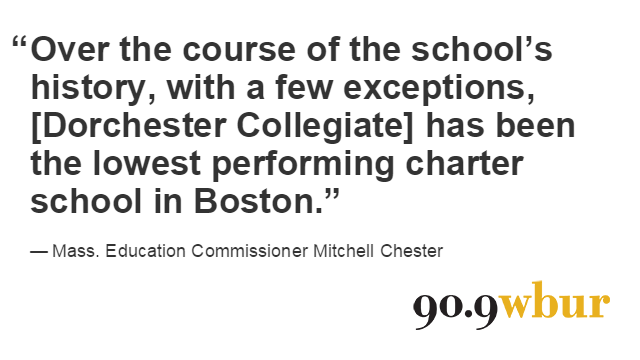
"Over the course of the school’s history," writes Chester, "with a few exceptions, [Dorchester Collegiate] has been the lowest performing charter school in Boston."

Chester cites the school's low test scores, high attrition rates and lackluster enrollment as reasons to close the seven-year-old charter school, which serves about 200 students in grades 4-8.

Read more of State May Shut Down Dorchester Charter School →

Reporter's Notebook

State Declares Madison Park High School 'Underperforming'

Updated December 9, 2015, 5:23 p.m.

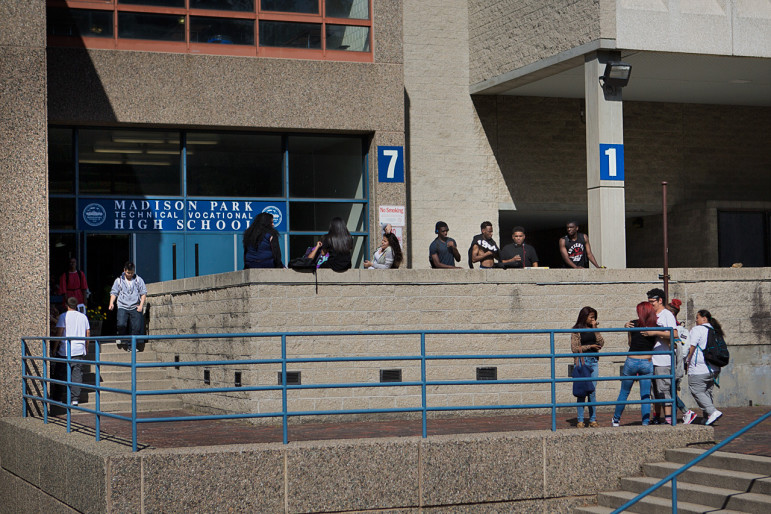
Massachusetts education officials on Wednesday designated a long-troubled Boston vocational high school as "underperforming," as they released annual state accountability results for schools across the state.

Madison Park Technical Vocational High School is the only newly identified underperforming school this year, a shift from last year when six schools were given that status. There are 15 schools in total labeled as underperforming.

The distinction is based on tests scores, plus graduation and dropout data.

The vast majority of Boston Public Schools (BPS) did not see their status change. Three BPS schools significantly improved. Madison Park is one of five Boston schools that saw their accountability status decline.

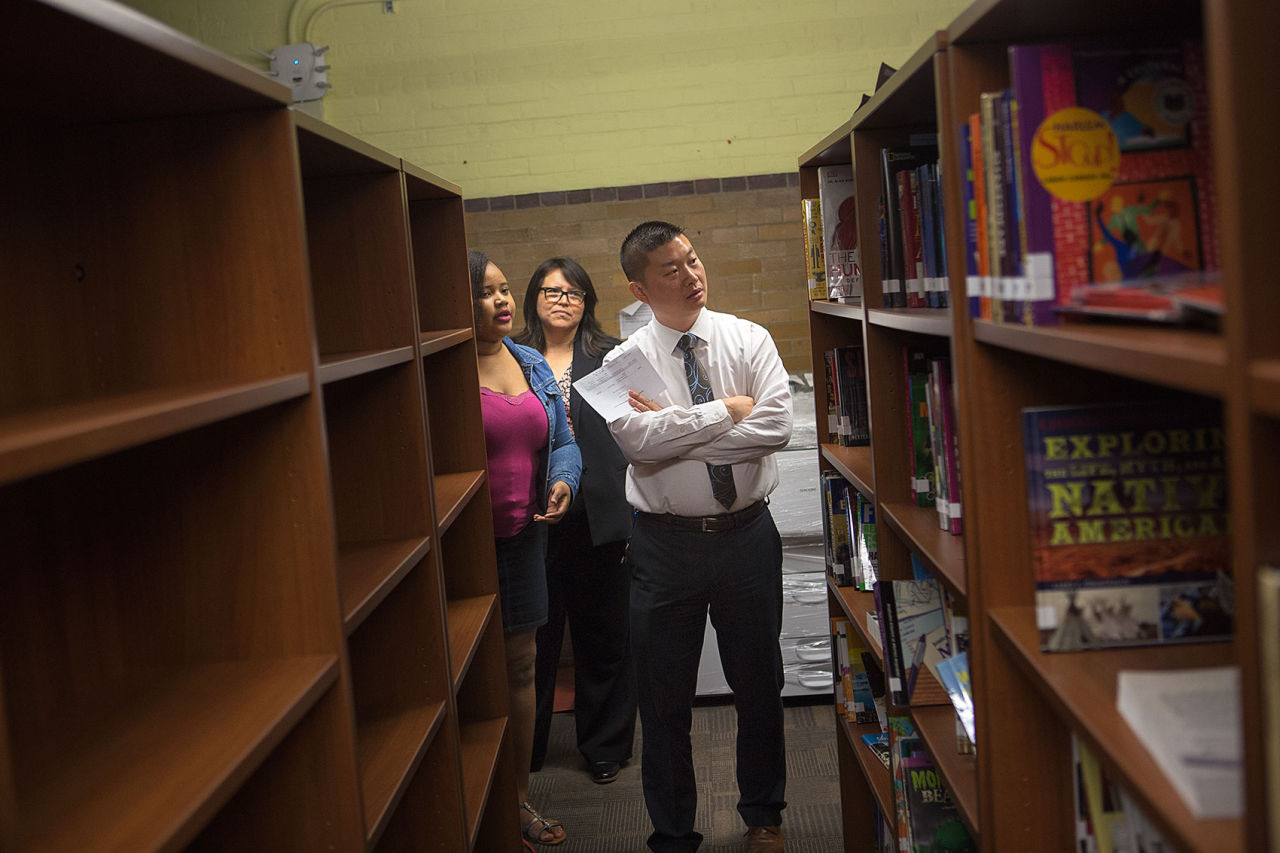
Boston Superintendent Tommy Chang said the district is aware that Madison Park has long been underperforming and that the rating could help "galvanize" a plan already in place to vastly improve the school.

Read more of State Declares Madison Park High School 'Underperforming' →

Reporter's Notebook

Report: Non-Academic Skills Are Key Ingredient To Student Success

BOSTON -- There's little doubt that skills that can't be measured by standardized tests still play a pretty big role in a student's education.

Skills like self-confidence, the ability to work well with others, attitudes toward learning, and control over one's emotions. Beyond making day-to-day life easier to navigate, these skills have long term effects in one's life.

They're associated with high school and college success, likelihood of future employment, higher earnings, positive health and smaller chances of incarceration. In fact, being proficient in those non-academic skills can result in impacts 40 years down the line, according to a report released Tuesday by Boston-based education nonprofit Transforming Education (TransformEd).

"The skills students need to become successful not just in school, but in their careers and their lives, include, very significantly, a set of skills that are not the focus of schools when [schools] only look at test scores," said Christopher Gabrieli, TransformEd co-founder and chairman.

Gabrieli, a one-time gubernatorial candidate, is also co-founder of the National Center on Time & Learning and a major player in the expanded learning time movement. He says his work in expanding the school day raised a very specific question: What skills do students really need?

While there is mounting evidence from researchers of the importance of these non-cognitive skills, there are a number of challenges when it comes to deliberately teaching, learning and measuring them in schools.

Read more of Report: Non-Academic Skills Are Key Ingredient To Student Success →

Reporter's Notebook

For Education Reform, Activists Turn To Ballot Initiatives

Updated December 3, 2015, 10:08 a.m.

BOSTON -- Education could be a red-hot topic on the 2016 Massachusetts ballot, with possible ballot questions on Common Core and charter schools.

On Wednesday, two groups hoping to shift the future of Massachusetts education submitted signatures calling for the ballot questions to the secretary of state's office.

One question would ask voters to reject the Common Core education standards and restore the state's previous standards. The other would ask voters to expand the number of charter schools allowed in Massachusetts.

Groups need to submit at least 64,750 certified voter signatures. If enough signatures are approved by the secretary of state, the questions will be sent to the Legislature for review in January, bringing the questions one step closer to appearing on the November 2016 ballot.

Read more of For Education Reform, Activists Turn To Ballot Initiatives →