Learning Lab
This is an archive of WBUR’s Learning Lab, which covered education in Massachusetts from 2013 to 2016.

June 2015

Reporter's Notebook

For 20th Year, Boston Provides Free Summer Meals For Youth

BOSTON -- School's out for the summer. For students it may mean a long-awaited break from endless homework, standardized testing and bus rides to school.

It also means a break from noisy school cafeterias and school lunches. But what about the roughly 43,000 Boston students who may rely upon their free and reduced meals to get food?

To address this, Boston Public Schools (BPS) on Wednesday kicks off its 20th summer of providing free meals to Boston children.

From July 1 through Aug. 28, free breakfast and lunch will be available at over 120 locations throughout the city. All Boston youth, 18 and under, are eligible to receive the two meals offered each weekday at the Boston sites.

The meal program is accompanied by phone (1-800-645-8333) and text (617-863-MEAL) hotlines that youth and families may use to find their nearest free meal options.

Read more of For 20th Year, Boston Provides Free Summer Meals For Youth →

Reporter's Notebook

U.S. Report: Mass.' Revised Method To Track Student Poverty Is Insufficient

BOSTON -- A federal guide for education agencies that outlines ways to identify student socioeconomic status says that Massachusetts' new method to track student poverty is not sufficient on its own.

As we reported Tuesday, Massachusetts has scrapped a decades-long practice of using free or reduced price lunch eligibility as a measure of student income. Instead, a student is now termed “economically disadvantaged” by the state if the student receives specific public benefits, including food stamps or foster care.

As a result, the number of students identified as poor has fallen dramatically.

The guide, released Monday by the National Forum on Education Statistics, offers Massachusetts' new method as one way to measure socioeconomic status, but says given the method's limitations, it should be used in combination with other measurements.

Read more of U.S. Report: Mass.' Revised Method To Track Student Poverty Is Insufficient →

Reporter's Notebook

State To Receive Initial Report On Adequately Funding Public Schools

The state committee that will craft recommendations for how the state should adequately fund public schools approved a preliminary report to submit to the Massachusetts Legislature on Tuesday.

At the State House meeting of the Foundation Budget Review Commission (FBRC), members put the final touches on a report that includes some initial findings on school districts' health care costs and spending on special education students.

The committee members also agreed to include in the report that the FBRC plans to analyze a number of other areas, including costs associated with lowering class sizes in early grades, wraparound services, extended learning time and educating English-language learners.

Read more of State To Receive Initial Report On Adequately Funding Public Schools →

Reporter's Notebook

How Massachusetts Redefines Low-Income Students

BOSTON -- Under a new state metric to determine whether public school students are economically disadvantaged, far fewer Massachusetts students will be counted as living in poverty, according to state data.

For years Massachusetts has used students' eligibility for free or reduced lunch to measure if students qualified as "low-income." Now, Massachusetts will scrap that method and instead deem students "economically disadvantaged" only if the student participates in one or more specific state-administered social welfare programs: food stamps, foster care, medicaid or transitional assistance for families with dependent children.

The altered method of counting students is expected to have major policy implications as fewer students across the state now count as low-income. Some educators are concerned that the new policy may inadvertently take away funding from districts and disenfranchise certain families.

Read more of How Massachusetts Redefines Low-Income Students →

Reporter's Notebook

5 Questions With Citizen Schools Co-Founder Eric Schwarz

BOSTON -- In order to battle achievement and opportunity gaps between lower and upper-income students, Citizen Schools chose longer learning days as its weapons of choice.

For two decades, the Boston-based non-profit organization has partnered with schools across the country to offer an extended learning day program for low-income middle school students. Their extended learning day program is led by volunteer teachers from various professions and supported by Citizen Schools teaching fellows.

Today, Citizen Schools partners with 29 schools across the nation. Six are located in Massachusetts.

Eric Schwarz, co-founder and former CEO of Citizen Schools, says more time at school can replace the activities that upper income students often benefit from -- robotics camp, academic tutoring, piano lessons, after school activities and more.

Read more of 5 Questions With Citizen Schools Co-Founder Eric Schwarz →

Reporter's Notebook

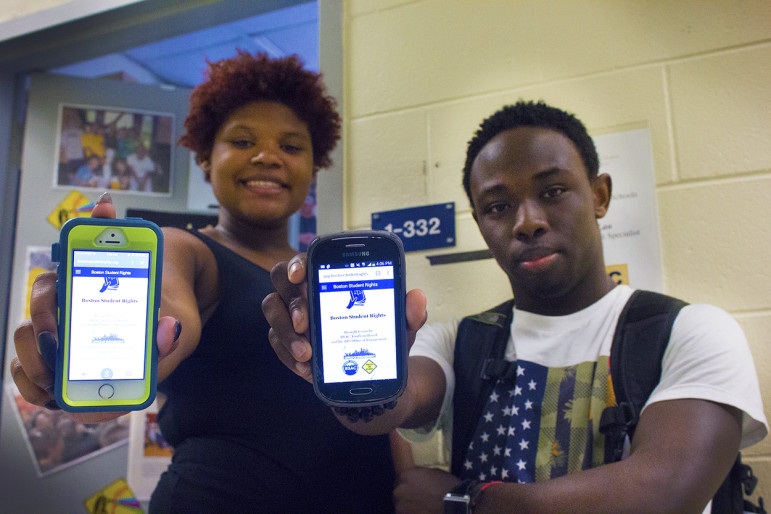
Why Boston Students Created A ‘Know Your Rights’ App

BOSTON -- A group of Boston Public School students have turned to the power and popularity of technology to empower peers to be aware of their rights while in school.

They’ve recently released the website and mobile phone app Boston Student Rights, which presents the district's student code of conduct in a condensed, simplified format. It includes information on subjects ranging from types of suspensions to cellphone policies, LGBTQ students' rights, teacher evaluations and dress codes.

Most importantly, the app also shares information on proper school discipline processes, highlights students' own rights and responsibilities as laid out by state law, and lists out legal aid resources available for students.

Read more of Why Boston Students Created A ‘Know Your Rights’ App →

Reporter's Notebook

Guest Column: Don't Short-Circuit Education

By Alden S. Blodget

Teachers can learn something from electricians. For example, taking the path of least resistance isn’t always the best way to go. If we want the lights to go on, the current needs to flow through the full circuit, and a shortcut, like a nail lying across the wire, usually results in darkness.

English teachers, for example, hope their students will become better readers, able to make sense of literature, but the path to this goal is long and difficult, requiring students to move beyond literal decoding to an understanding of metaphor, imagery, connotation and an ability to see meaningful patterns and then to link all these to their own experiences and understanding of the world.

So teachers often go for the result, forgetting the skills required to attain the goal.

Read more of Guest Column: Don't Short-Circuit Education →

Reporter's Notebook

Why Mass. Educators Are Calling For A Halt To High-Stakes Testing

BOSTON -- The debate is raging in Massachusetts education: Which standardized test will be best for Massachusetts' school children? Massachusetts Comprehensive Assessment System (MCAS) or Partnership for Assessment for College and Careers (PARCC)?

While state education officials are expected to answer that question this fall, for a growing group of Massachusetts educators the answer is simple: neither.

"The problem with high-stakes testing is that it narrows the curriculum," says Barbara Madeloni, president of the Massachusetts Teachers Association (MTA), the state's largest teachers union. "There's whole swathes of what's important about public education and about a child's experience in school that are not acknowledged in testing."

Read more of Why Mass. Educators Are Calling For A Halt To High-Stakes Testing →

Reporter's Notebook

Lawrence Schools Under State Control For At Least 3 More Years

The public school system in Lawrence will stay under state control for at least three more years, according to a renewed turnaround plan developed by the state-appointed receiver and the state's commissioner of elementary and secondary education.

Although Lawrence Public Schools has seen improvements in test scores and graduation rates since being taken over by the state in 2012, state officials say there's more homework to be done before local control is reinstated.

The turnaround plan details the strengths and weaknesses of the takeover so far and lays out plans for additional improvements in the district through 2018.

Read more of Lawrence Schools Under State Control For At Least 3 More Years →

Reporter's Notebook

As Massachusetts' Urban School Districts Face Funding Struggles, One Considers State Lawsuit

In Fall River, schools will start the fall $2.6 million in the red. Boston faces budget shortfalls that will result in the closing of two schools. Lynn Public Schools face an $18.6 million gap between available funds and the money the state requires the district to spend to provide students an adequate education. New Bedford plans to close a school to trim costs.

In Brockton, the current budget proposal includes as many as 125 teacher layoffs, and more than 60 cuts to other positions, in the wake of spending shortfalls.

Collectively, urban districts that rely on state funding are struggling in Massachusetts.

"When I'm laying off this many teachers, we are looking for solutions in a large urban district," said Kathleen Smith, Brockton's superintendent of schools. "And I'm out of solutions."

Read more of As Massachusetts' Urban School Districts Face Funding Struggles, One Considers State Lawsuit →