Data Challenge Invites Hackers to Help Enhance Education Policies
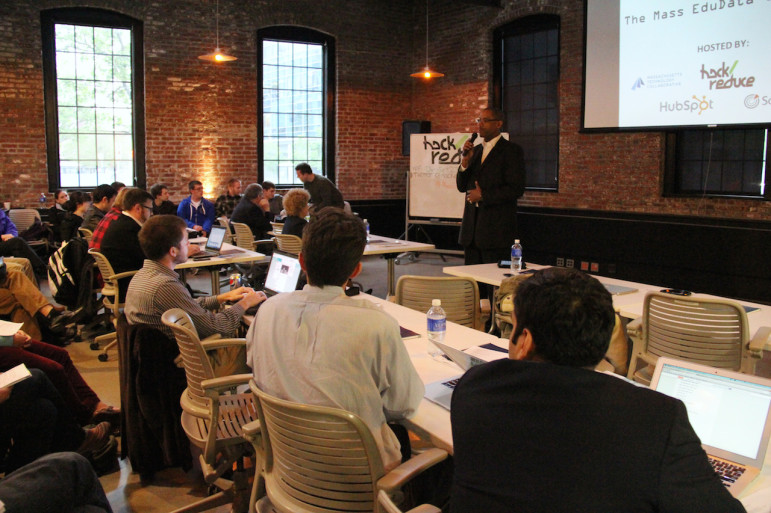
More than 60 civic hackers, developers, and students have spent the past month poring over troves of Massachusetts school data as part of the six-week Mass EduData Challenge hackathon. Their goal: to create tools to analyze and find education trends.
The data, provided by the Massachusetts Department of Elementary and Secondary Education (DESE), dates back to 1995 and spans 351 cities and towns. Competitors are tasked with analyzing the education data, identifying relationships with external data sets, and providing insights in a user-friendly manner.
Participants may -- or may not -- have a background in education.
"I was really interested in seeing how the education system here in Massachusetts works," said David Lago, an application architect participating in the challenge. "I was interested if there was any way that we could make the information more accessible for people."
In the past month, Lago and partner Christopher Buck have pooled all of the available data into a single database to make it easily accessible for users and applications.
They are just one of 20 teams working to create tools -- websites, mobile apps, and other software applications -- that will engage the public and may help inform the Commonwealth’s education policies.
"Trends really begin to emerge when you have 20 years worth of data," said Sharon Wright, Secretariat Chief Information Officer for the Executive Office of Education.
Organizers believes this approach to analyzing test data across the state will help educators to understand why some programs are more effective than others.
"For instance, you can do a very close analysis of how individuals are performing on standardized tests, even how much time they spend on specific questions," said Pat Larkin, Director of the Innovation Institute at the Massachusetts Technology Collaborative, whose organization is co-sponsoring the event.
The challenge was developed in conjunction with Governor Deval Patrick's 2012 "Big Data Initiative" aimed at expanding Massachusetts' position in the analytics sector.
Big Data is the collection and analysis of large amounts of data. Tony Parham, Government Innovation Officer for the Commonwealth of Massachusetts, opened the data to those he believes are most suited to analyze it -- hackers.
"We can leverage the insights and skill sets of the folks in our extended community who are, first of all, very passionate about civic innovation and, second of all, they have specific skill sets, whether it be in application development, user experience design, data analysis, or visualization," Parham said.
Utilizing big data does come with security concerns. In April, inBloom, an ed-tech project providing open-source software to store student data from multiple sources, shut down over concerns about student data privacy.
According to school officials, the graduating class of 2014 is the first class to have detailed data tracked since kindergarten.
Parham, assures that the Commonwealth and its partners on the competition take privacy "extremely seriously."
"We work to ensure that the target data sets do not contain P.I.I. (personally identifiable information) of any student or teacher in the Commonwealth," he said.
The competition wraps on July 8th. In the next few weeks Learning Lab will continue following the competition with profiles on challenge participants.