Nearly 50 Years In, METCO Seeks To Foster Diversity, Faces Challenges

This school year will mark the first time there are more students of color in public schools than white students, a recent study by U.S. Education Department shows.
Studies show that experiences with diversity can result in significant benefits to student learning, yet many schools in Boston remain racially imbalanced, while districts in the surrounding suburbs are racially isolated.
There is one busing program that has been working to confront this problem of racial isolation and segregation head on for almost 50 years. But the program faces ongoing funding challenges, even as its need is increasingly relevant today.
METCO, Inc. buses non-white students from Boston and Springfield to majority-white suburban school districts. Nearly a quarter of the 37 districts that enroll METCO students today are over 90% white, with only five that are less than 70% white, according to the Massachusetts Department of Education.
METCO's Origins
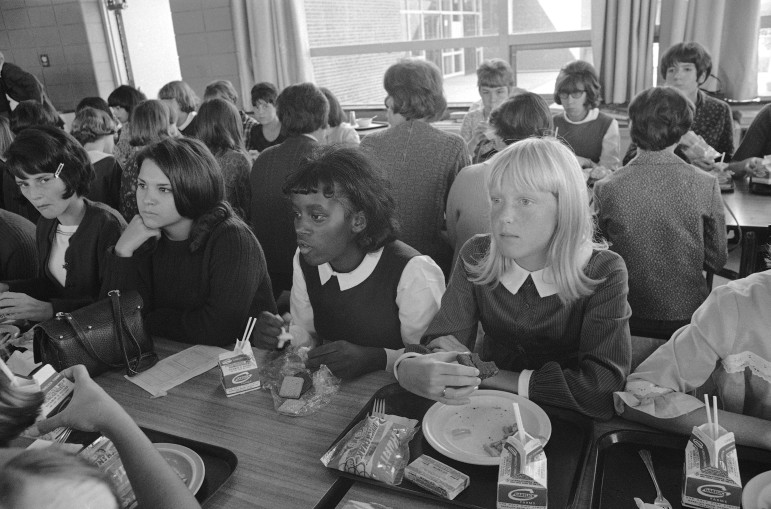
In the mid-1960s, concerned black parents and activists in Boston organized to transport their children from overcrowded and underfunded predominantly black schools in Roxbury and Dorchester to predominantly white, but under-enrolled schools in Back Bay.
This project, known as Operation Exodus, laid the foundation for METCO.
In 1965, Massachusetts passed the Racial Imbalance Act, mandating that school committees work to eliminate racial imbalance in public schools and that the state could withhold funding from any district that did not develop a plan to remedy racially imbalanced schools.
The law focuses on non-white students: A racially imbalanced school is one with more than 50 percent non-white students.
By this definition, an all-white school isn't considered imbalanced, and the law had no effect on the majority of suburban school districts. Instead, the law would only apply to schools in Boston and Springfield and paved the way for court-mandated busing and desegregation in Boston.
In 1966, years before court-ordered desegregation, METCO was born to institutionalize and expand on the role that Operation Exodus played.
Following District Court Judge Arthur W. Garrity's 1974 order to desegregate Boston public schools, a significant portion of Boston's white population left the public school system.
Since 1975, students of color have made up the majority of Boston Public School students.
METCO's Goals Today
Today, METCO buses around 3,300 non-white students from Boston and Springfield to 37 suburban districts.
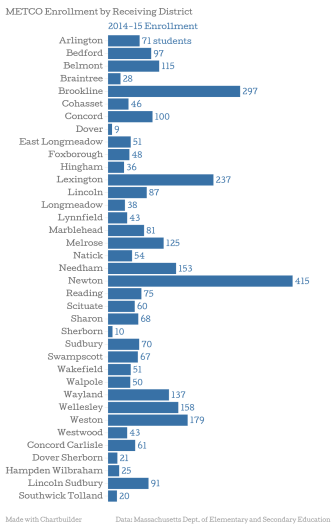
The Massachusetts Department of Elementary and Secondary Education says the "METCO program was started in the 1960s to provide enhanced educational opportunities for participating students, to reduce the racial isolation of suburban school districts, and to reduce segregation in city schools."
David Fuller, former Director of Weston's METCO program has since conducted external reviews of various METCO programs in the state. He believes the program has lived up to its goals.
"It definitely created a positive partnership that worked to break down isolation," Fuller said.
John Shandorf, Associate Director of METCO, Inc., says this aspect of the program continues to entice districts to participate.
"They know that a racially isolated school system is not optimal to education," Shandorf said.
METCO provides a much-needed opportunity for students at an early age to develop relationships and interact with people that share different cultural, ethnic, and racial backgrounds. And it provides a way for Boston and Springfield students to access school systems they would otherwise be barred from.
"Not much has changed in the affordability of many of these participating districts," Shandorf said. "Many of our participants are over-represented in not being able to afford those districts. The program is still appropriate today just as it was appropriate at the time the program was developed."
Lack of Funding And Challenges
Despite METCO's ongoing relevance, funding has steadily decreased. Since 2008, METCO's funding has fallen by almost 20 percent.
METCO is funded separately from K-12 spending, meaning the program must fight for its existence each year. No new districts have been added since 1978, Shandorf said.
"We have been trying, for many years, to use the legislature to get adequate funding for the districts that participate in the METCO program," Shandorf said.
The average amount given to receiving districts is $3,581 per student this year, but most districts spend far more -- between $15,000 and $20,000 per student.
"Whenever there's a discussion about expanding the program," Shandorf said, "the participating districts often indicate, 'We'd like to take more students in order to increase the critical mass of METCO students in our district.'"
But, with current funding that seems an unlikely possibility. As student enrollment grows rapidly in Boston's suburbs, finding open seats for METCO students is posing an additional challenge.
"When you have participating districts that are 90 percent Caucasian, you may have a district with only 40 or 45 [METCO] students," Shandorf said. "If you look at that spread out, you're only talking about one or two students per classroom. If we were able to have more students in these participating districts, my sense would be that it would open up more interacting opportunities with the resident students."