Thomas Menino: Boston's 'Education Mayor'
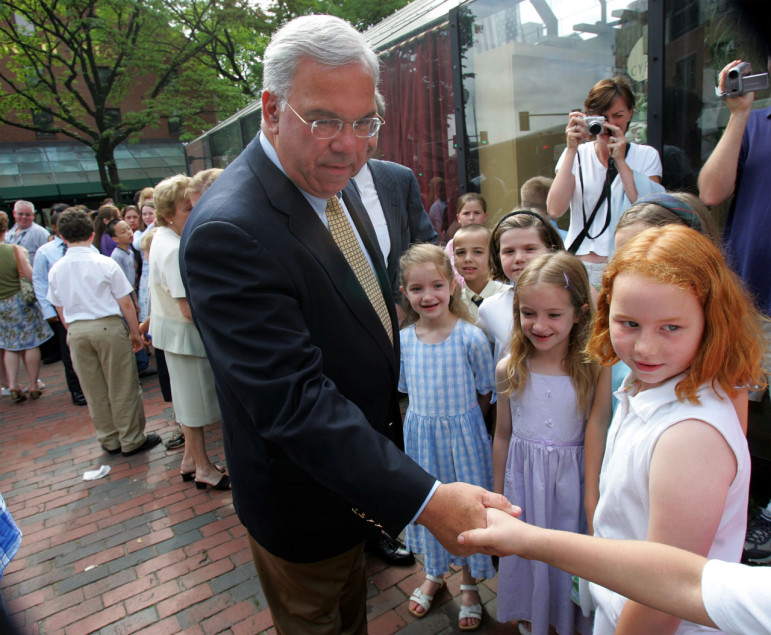
In his State of the City speech in 1996, delivered to a packed crowd at Jeremiah Burke High School, Mayor Thomas M. Menino famously said if he failed to improve schools in Boston "then judge me harshly."
"I want to be judged as your mayor by what happens now in the Boston public schools," he said the same night.
Menino, often proclaimed Boston's "education mayor," died Thursday. He was 71.
Menino, a man who championed education, saw school progress in Boston schools during his tenure including higher test scores, a decline in dropout rates, full-day kindergarten available for all 5-year-olds, a home-based school assigment plan and rising college completion rates from Boston high school graduates.
In the Boston Globe, Scott Given remembers how, in a 2010 conversation, Menino was thinking about how his remaining time in office could be focused on Boston's education.
The mayor asked me if I’d help him fulfill his vision for transforming the city’s lowest-performing schools into extraordinary schools. As he emphatically made his pitch, the magnificence of Tom Menino emerged. He spoke from the heart about the plight that could await children without a high school diploma. He talked about all of Boston’s kids as if they were his own. He humbly acknowledged the limits of the progress some of the city’s schools had made during his first 17 years in office. He embraced personal accountability for the performance of Boston’s district schools.
While many other big city mayors viewed education as a political “third rail,” and thus kept their distance, here was our mayor, with his sleeves rolled up, literally, as he orchestrated a plan by which the long-struggling Gavin Middle School would become UP Academy Boston, a school he envisioned that would give students access to great teachers, an extended school day, enrichment and arts, and a wide network of supports to ensure their academic progress.
With a pointed determination clearly sharpened through many years of beating the odds, he told me: “The children at the Gavin will learn.”
However, in 2013 Menino admitted he was not fully satisfied with the school system.
Despite his best efforts, problems have continued to persist. Gaps in academic achievement between white students and students of color remain, at Menino's cherished UP Academy less than two-thirds of students met proficiency standards in 2014 and the district has consistently scored lower on MCAS tests than the state average.
Even so, through the years Menino gathered national attention for his commitment to overhauling the school system. He was one of the few mayors nationwide with considerable control of the city's school system. The mayor has the power to appoint School Committee members and plays a key role in selecting the superintendent.
For his accomplishments in public education, Menino was one of the subjects of the 2007 book "The Education Mayor: Improving America's Schools."