New England Education Forum Highlights Concerns About High-Stakes Testing
BOSTON -- For years New England states have outperformed other states in indicators of educational achievement and well-being. According to the 2014 Kids Count Databook, Massachusetts, Vermont and New Hampshire are included among the top five states with the best public education. Massachusetts has hovered in or near the top spot for years.
What can explain this success? Is there something special in New England's waters or do the states have more in common that could explain their flourishing education records?
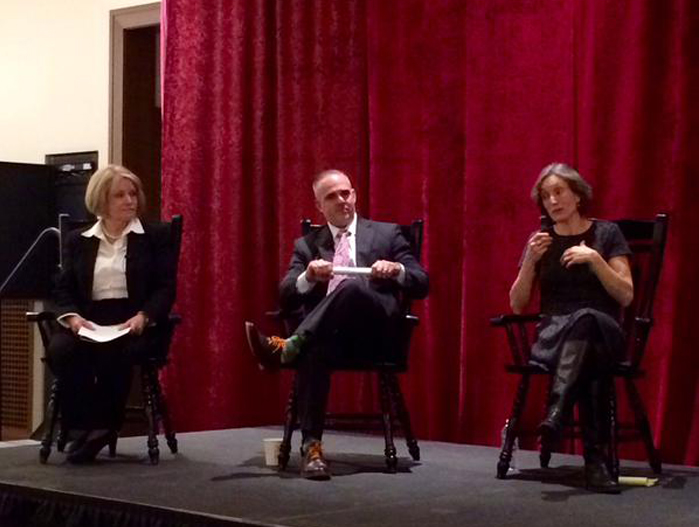
The States of Success forum held by the Boston College Lynch School of Education explored this premise on Monday evening. About 80 people gathered in Boston College's Heights Room to hear Massachusetts Secretary of Education Matthew Malone, New Hampshire Commissioner of Education Virgina Barry and Vermont Secretary of Education Rebecca Holcombe talk about public education in their respective states and how it relates to their New England neighbors.
High-Stakes Testing Raises Concerns
Of chief concern for each of the states was the method and amount of high-stakes testing facing children and teachers.
"Assessments have gone wild in Massachusetts," said Malone. "We've jumped the shark."
Last month, in response to complaints by teachers, parents and students that taking and preparing for standardized tests was impeding on classroom instruction time, Massachusetts officials ordered an independent review to assess the scope and impact of standardized testing.
Holcombe says she also sees overtesting in Vermont.
Tests have become tools attached with harsh consequences, rather than as a way to monitor teacher and student progress. This, Holcombe believes, sends Vermont students a very specific message: fail once, and you are less than adequate.
Students may dismiss the possibility of passing "some day" and give up on the testing -- and school -- altogether. A study of high-stakes testing revealed that states with the highest dropout rates use competency tests with higher stakes and less flexible standards.
"When we use these tests as we are using them," Holcombe said, "we erode their very purpose."
Competency-Based Education And No Child Left Behind Waivers
Barry said she would like to see tests supporting a competency-based education in New Hampshire, a waiver state. States granted waivers under No Child Left Behind (NCLB) craft their own individualized educational plans that fall outside of NCLB standards. The federal government approves the state's plan and the state will not be punished for failing to meet the NCLB standards.
Barry hopes to develop a new waiver so that New Hampshire may expand its performance-based assessments.
"We need to use tests to monitor, not consequentially," Barry said.
Assessments are necessary to maintain quality education, Malone agreed, they just must be implemented with discretion.
"I'm anti too much assessment," he said.
Most states, Massachusetts included, have NCLB waivers. Vermont is one of nine states without a waiver.
Lessons From Neighbors
State leaders overwhelmingly agreed that they have much that they can learn from one another.
Holcombe said that Vermont's teachers could learn from the systematic approach to teaching that Massachusetts teachers use. Massachusetts, she said, is a good example of how teaching must not be applied in an "ad hoc" manner.
In New Hampshire, Barry hopes to see similar partnerships between the private sector and public schools that happens in Massachusetts. She said she admires how invested the public is in the state's school system.
While much of the forum focused on how the states could close achievement gaps for students living in urban, poverty-stricken environments, Malone said there were many lessons Massachusetts could learn from Vermont and New Hampshire best practices to work with students living in rural poverty.
English Language Learners
When the three participants were asked to describe their biggest challenge in addressing the achievement gap that English language learners (ELLs) face, they all agreed that educating ELLs is one of the most pressing issues in public education. However, when pressed to describe how they actually planned to support ELLs, all were more vague.
Focusing on ELL education and finding the best practices gives Vermont a great opportunity to "look at ourselves from the outside," Holcombe said.
"This is the most pressing issue in our industry," Malone echoed, but did not elaborate about practices that Massachusetts can use.
States Of Success And Beyond
"It's really wonderful to have the leaders of three strong states in one room," said Andrea LaRocca, a student in the doctoral program for Educational Leadership at Harvard. After graduation she hopes to continue on in education.
Although she was enthusiastic about the forum, there are topics she wishes the panelists would have explored further.
"I would have loved to hear more about students in rural communities," LaRocca noted. "There's a real division between urban, suburban, and rural settings."
Malone welcomed the opportunity to engage with the other state education leaders and hopes there can be more collaboration in the future.
"What I'd like to see us doing is more teacher collaboration across states," Malone told Learning Lab. "How can we do leadership exchanges? How can we share ideas of best practices so we continue to grow? Those are discussions I'd like to see us do more."