Inquiry-Based Arts And Engineering Space Enriches Student Learning
MALDEN, Mass. -- When Eddie Urbina decided that he wanted to create a mobile platform for his drum set in the hopes of awing fellow students at this year's "Junior Varieties" talent show at Malden High School, he turned to the new workshop in the basement of his school.
"I thought, 'It's my senior year, why not go go all out?' " said Urbina on a recent Wednesday afternoon sitting atop his new mobile drum platform. "I made a simple sketch design and then I came down here to ask for help. About a month later here we are."
Urbina is in Nedlam's Workshop, a recently restylized, formerly underutilized woodshop in the basement of Malden High School. Nedlam -- Malden spelled backwards -- is also the name of the school's lion mascot.
Over the course of this school year the space has turned from a near-abandoned woodworking shop into a humming hub for inquiry-based arts and engineering projects at the high school.
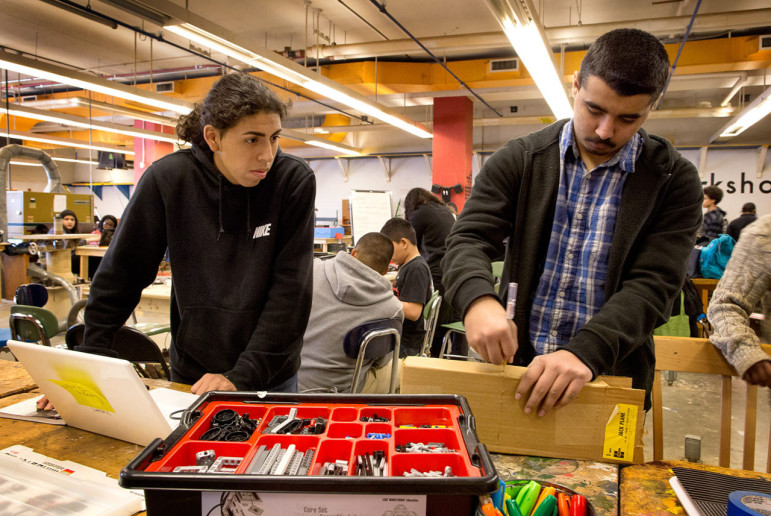
The space now boasts brightly painted walls, woodworking tools and equipment, numerous Lego EV3 robotics sets, a 3D printer, electronics and circuitry stations, soldering materials, and a guitar-making area. The space is open for students to use after school and, this term, it's home to a brand new school-day elective.
The Elective Class
On Monday morning, 21 students congregated around a set of long wooden tables in the sun-splashed Nedlam's Workshop. Their task: design and create a device to keep a phone charged safely in the back of a classroom, without fear of theft or damage.
"Two weeks from Friday is going to be your final pitches, which are presentations about your designs for this challenge," Daniel Wise told the attentive students. Wise, an educator in residence at Tufts University's Center for Engineering Education and Outreach (CEEO), is the teacher for the workshop's elective class.
The students, divided up into pairs, explored options to create a prototype of their secure cellphone-charging devices using cardboard boxes and Lego EV3 robotics sets. Each team's EV3 set was connected to a laptop, which allowed students to build and program mechanical robotic Lego parts to include in their designs.
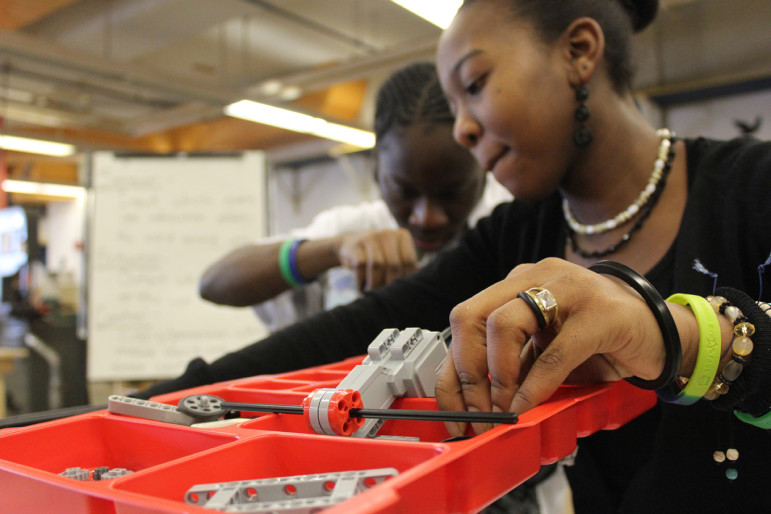
Tenth grade partners Khadija West-Akarkouz and Desiree Delgado used the EV3 set to program mechanical latches that will open and close the box. The pair built parts out of Lego pieces then, using the EV3 software, programmed them to move.
"Right now, I'm working myself to try and make the motor actually move at like maybe a 90 degree angle and then stopping," West-Akarkouz said as she excitedly typed into the pair's laptop.
The two students explored different options to create the mechanical part, using a style of learning they said is decidedly different from the learning taking place in other parts of the school.
"It's one of those fun classes where, yeah, I get to learn and have fun at the same time instead of just sitting down writing, taking notes all day, then taking a test or a quiz, sitting bored out of your mind," West-Akarkouz said.
Delgado agreed. Delgado is immersed in sports -- she plays for the school's lacrosse and soccer teams -- and said that taking this class seemed like a good option to explore her creative side.
"You're working, like, independently on creating new designs and you're not being judged on it," Delgado said. "So it's like any idea you have is, like, a good idea."
"One thing that is really exciting about this space is that it appeals to people who ordinarily may not be voluntarily signing up for engineering activities," teacher Wise said. "The class is half women, as is our after-school program, there are a lot of English language learners, and there are students who may not be successful in traditional school subjects."
A Student Driven Transformation
The workshop space didn't always look like this.
Due to a lack of funding, the woodshop space had no teacher and was used only intermittently by other teachers in the school for the past two years.
"We're talking an hour or two a week out of a 40-hour week where it was being used," said Dana Brown, principal of Malden High School. "It was really a poor use of a great resource."
The city of Malden, Brown says, eyed the nearly unused space as a shop to take over for its own use.
"What often happens in municipalities is that people look at very large, well-equipped spaces and when they go unused they think of ways to use them," Brown said. "We were concerned that if we didn't make an educational use out of that space that they city would have its sights on that space for other uses."
So Brown reached out to Brian Gravel, a Tufts University lecturer and director of elementary education, to use the space for educational purposes.
Gravel and colleagues secured a two year, $300,000 grant from the National Science Foundation to explore the role of "maker spaces" in urban high schools.
"The research question is how can we use digital maker practices -- engineering, inquiry and digital technologies -- to empower youth to feel as though they can solve problems in the world?" said Gravel.
A maker space like Nedlam's Workshop, Gravel says, is a space that blends "older craft technologies with newer digital technologies in service of kids asking questions about the world and then solving them by making things."
Starting in September, after the grant was secured, a team of dedicated Malden students, Tufts undergraduates and graduate students toiled at school after hours to restylize the sparsely used space.
"The transformation of this space, a lot of it has been student driven," Wise said. "We organized it, we figured out which machines worked and which didn't, we painted the walls and put them on the walls -- they painted themselves up there. We organized it for more fluid work, we got the rusty nails off the ground."
It's this kind of space for inquiry-based learning, that the Tufts researchers hope to explore.
Maker Space: What's The Point?
"Historically when you look in schools where there is inquiry-based learning, it's the kids who are sort of on the most high-track academic track who get that in their classes and the kids who are not there tend to have much more traditional didactic instruction," said Ben Shapiro, a McDonnell Family Professor of Engineering Education at Tufts University, who helped secure the grant.
"We wondered if we could ... create conditions in the school where all kids, including the kids who are not seen as the most-likely academic high achievers, get to do inquiry as part of their everyday learning," Shapiro said.
Inquiry and arts-based learning has been shown to have a positive impact on students' overall academic experiences, especially among students from low socioeconomic backgrounds. At Malden High, roughly 65 percent of students come from low-income families.
A recent report shows that eighth graders from low socioeconomic backgrounds who had high levels of arts engagement showed higher test scores in science and writing than did students who had lower levels of arts engagement over the same period.
The same report shows that students from low socioeconomic backgrounds with intensive arts experiences were three times more likely than students who lacked those experiences to earn a bachelor's degree.
Afterschool Program And Student-Led learning
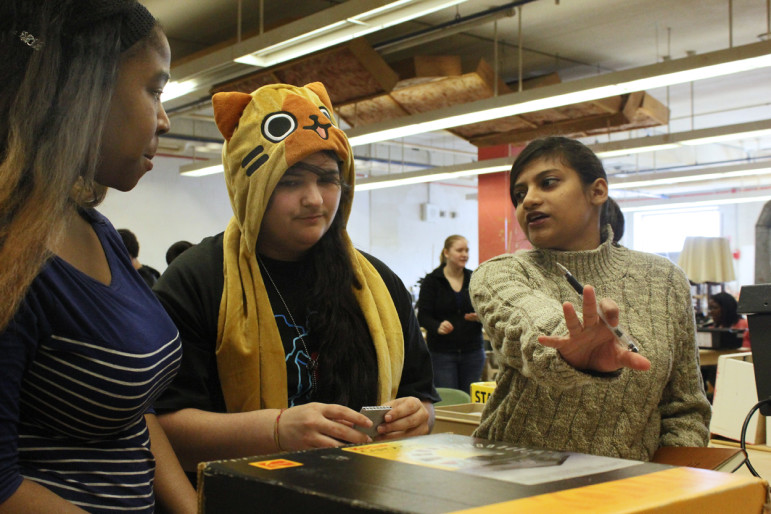
Nedlam's Workshop has truly become an area of student-led learning. The team that oversees Nedlam's Workshop during its open after-school program is primarily made up of Tufts undergraduates.
The space is open for use by any student who stays after school.
Nicolas Lusardo, a senior at Tufts, has experience running a similar space for hands-on projects in the basement of a Tufts dormitory building. Now, he spends 15-20 hours each week in Nedlam's Workshop after school hours.
"I think it's really great that the students here are working with a range of tools and materials ranging from the old wood that was left here to the newer electrical stuff," Lusardo said. Students have been working on various projects from woodworking to 3D printing to robotics after school.
Miki Vizner works in the space during both the after-school program and the daytime elective class.
"This space has the opportunity to give students creative confidence, which, I think, is something that is not thought about a lot of times," Vizner said. "A lot of times if you hear 'maker space' people think you drop off a 3D printer and a bunch of electronics and suddenly you have a world full of kids that can build robots and dinosaurs and animatronic heads of themselves. But that's not how it works."
What's more important, he says, is to have a space for all students to safely nurture ideas that may lead to innovations, and instill the confidence to create.
If the buzzing atmosphere at Nedlam's Workshop is any indication, Malden High School is well on its way to creating that space.