The Big Question About Schools And Budgets
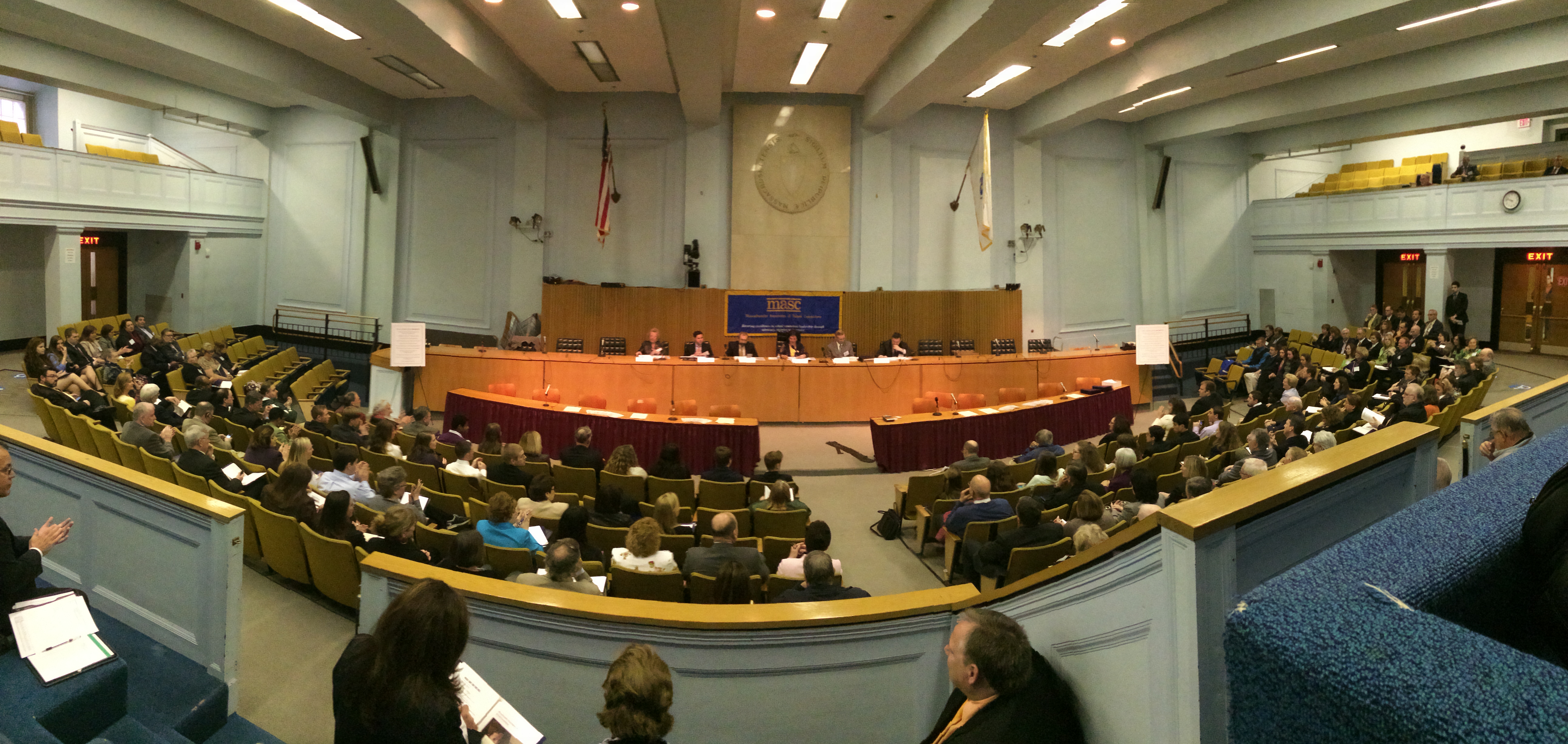
As state legislators debated the education section of next year's budget in the House chambers overhead, Massachusetts Sen. Sonia Chang-Diaz sat in a basement auditorium Tuesday at the State House with local school committee members and fielded what she believed were several versions of the same question.
"How do we pay for the things that we know are going to work in education?"
Members of the Massachusetts Association of School Committees gathered Tuesday for their annual "Day on the Hill," a chance for representatives from towns across the Commonwealth to discuss issues in public education with state policymakers.
A man from the Mohawk Trail Regional School System in the western part of the state, where many students travel several miles to school each day by bus, asked about funding for transportation.
A black student from Framingham High School who said he is one of just two people of minority backgrounds in his upper-level history class asked about the distribution of resources through Chapter 70 state financial aid to public schools.
He also asked about potential expansion of the Metco Program, a state-funded grant initiative that is "intended to expand educational opportunities, increase diversity, and reduce racial isolation, by permitting students in certain cities to attend public schools in other communities that have agreed to participate."
Another man stood at the microphone and questioned how legislators were working to ensure that healthcare spending on Baby Boomers does not prevent education funding for children.
Chang-Diaz, a Democrat from Boston who co-chairs the Joint Committee on Education, finally paused and said the questions were reiterations of a single quandary: budgeting. The process, she said, is like yanking on a blanket. Legislators have a plethora of issues they need to cover with only a single overstretched quilt. Pull it one way and you expose one issue, pull it a different way and you expose another.
Representatives upstairs, she said, were engaging in this very process as she sat with the school committee members, and there is simply not enough funding to cover every need.
Legislators can "be really aggressive about the places where we do find waste," she said, but even if they managed to eliminate all unnecessary spending, there still probably would not be enough to cover every significant cost. The only way to get a bigger blanket would be through new revenue collection schemes like raising taxes, Chang-Diaz said. But tax increases are a political lava pit that few elected leaders are willing to step near.
So, she said, "There's no good answer there."
Aside from funding, members of the school committee association also discussed their legislative priorities for the next year, which largely consist of problems commonly raised by public school advocates across the Commonwealth. They seek local control, deregulation, and a tougher stance on charter schools from elected leaders.
Patrick Francomano, the association's president-elect, said decisions about education policy should primarily be left up to school committee members who live in and care most about their districts. Increased state and federal regulation and the influence of charter schools that do not answer to the district school committees are threats to local control, according to Francomano.
"Public education and local control are being undermined on a daily basis," he said.
Charter schools in particular are a live wire in state education discussions. For more on the debate, see Learning Lab's Charter Cap page.