Federal Guidelines For Teaching English Language Learners Highlight Access, Civil Rights
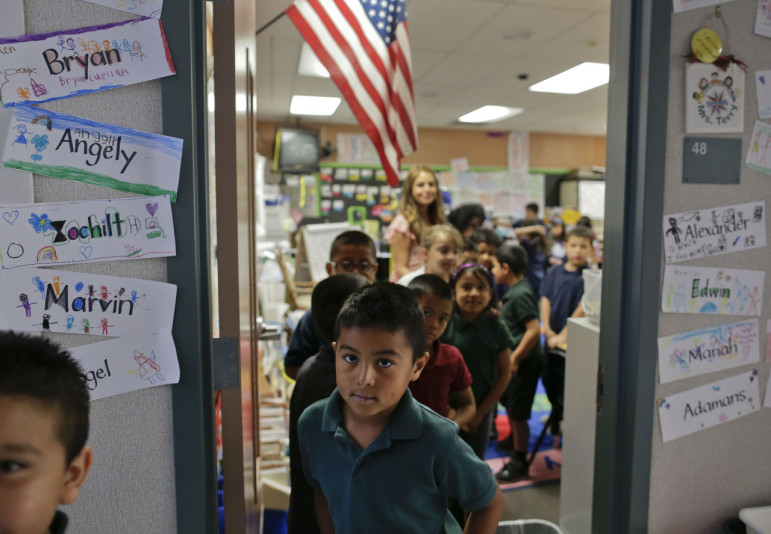
Students learning English as a second language and not yet academically proficient in English - otherwise known as English Language Learners (ELLs) - make up almost 30 percent of Boston's student population.
The federal government now has an eye on these students with a set of national guidelines for English Language Learners released Wednesday.
"English Learner students exhibit a deep desire to learn and engage in their classrooms, yet often face multiple barriers in their quest to do so," said acting Assistant U.S. Attorney General Vanita Gupta in a statement.
The guidelines highlight the civil rights of students learning English and their parents to have equal access to education and academic opportunities. The guidance is the first in 24 years to specifically address the rights of English learners.
It comes 40 years after the Equal Educational Opportunities Act of 1974 that prohibits discrimination and requires school districts to take action to overcome barriers to students' equal participation.
"They're not new rules. It's that they've repackaged them and they made it more accessible for districts to understand," said Antonieta Bolomey, Assistant Superintendent for English Language Learning for Boston Public Schools.
The requirements include providing students with sufficient resources for meaningful programs with qualified teachers and instructional materials, avoiding unnecessary segregation of ELL students, and monitoring the progress of all ELL students with language proficiency assessments.
Earlier this fall, Boston implemented a new program to monitor the progress and services for ELL students in all district schools.
"We can track them wherever they are, in any school or any grade," said Bolomey. "We also monitor to ensure that students receive English as a Second Language classes as required by the state and that every teacher that teaches a core content area is qualified for Sheltered English Instruction."
In Sheltered English Instruction, teachers create an instructional environment where students can access course content and concepts, while simultaneously learning English.
The new guidelines, not limited to students, extend to cover communication with parents who may not speak English.
Schools must provide translation or interpretation from "appropriate and competent individuals" beyond students, siblings, or untrained school staff for parents.
At Josiah Quincy Elementary School in Boston's Chinatown, over half the school is made up of ELL students. Over two-thirds of the students do not speak English as a first language.
P.K. Chan, assistant principal at Josiah Quincy, says that for years the school's notices and newsletters have been provided in both English and Chinese. Staff are also on hand to translate for parents, when needed, at events like parent-teacher conferences.
"We want to let the parents know that their child's education is important and that they should be part of it," said Chan. "There shouldn't be any gaps in those conversations with the families."