How One Student Went From Illiteracy To The Top Of Her Class
BOSTON -- This Saturday's 69th Annual Boston Citywide Science Fair will feature the best and brightest of Boston Public Schools' (BPS) budding student scientists. Roughly 350 students will publicly present projects related to science, technology, engineering and math.
The students will be vying for prizes in the form of scholarships, grants, a chance to advance to the statewide science fair and, for top prize winners, a coveted place at the annual Intel International Science and Engineering Fair (ISEF) in May.
Last year, Boston students did just that. Perhaps most well known is Nathan Han who, as a freshman at Boston Latin School, won top honors at ISEF and took home the $75,000 Gordon Moore Award.
Yet, Han was just one of four Boston students who won the chance to go to ISEF to present their projects. Another was Audrey Lang. This year she's a senior and again has an eye on the Citywide Science fair.
No Stranger To Science Fairs
This isn't the first science fair for Audrey Lang. The cheery senior and valedictorian at Edward M. Kennedy Academy for Health Careers can still remember her very first science fair project.
"I did my first science fair project when I was in first grade. It was whether ice could melt if it was put in cold water and put outside," Lang recalled on a recent Tuesday afternoon at the school. "I think I concluded that it wouldn't melt, but it was about a two minute experiment so... [laughs]"
For Lang, things have certainly progressed since then. She's attended the Citywide Science Fair and state science fairs every year since ninth grade. This year will be her last.
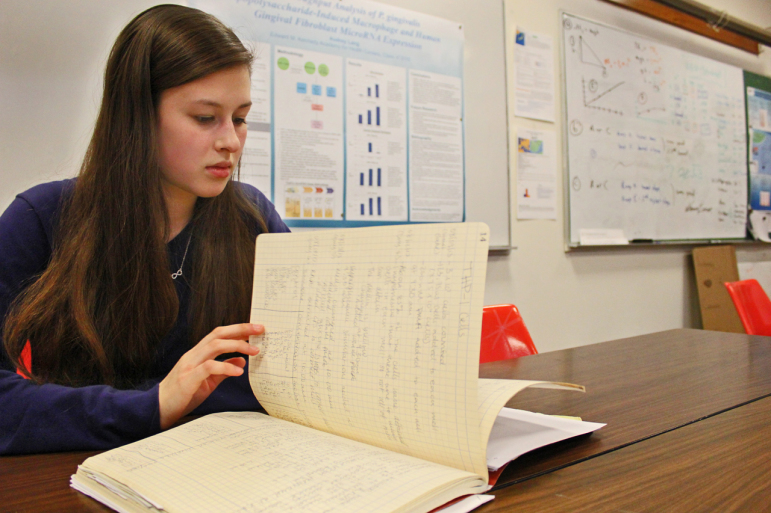
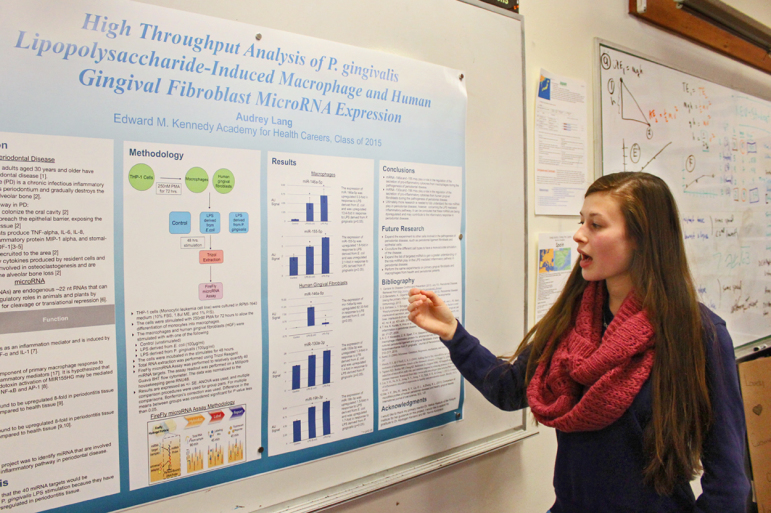
"I'm looking at -- and this gets pretty technical, pretty quickly -- something called microRNA, which is a really new and hot topic in genetic research," Lang said. "I'm looking at it in the scope of inflammation associated with periodontal disease. "
The project consists of entirely original research. By stimulating different cells in a lab and recording their reactions, Lang identified five specific microRNA that play a role in the development periodontal disease, or disease of the gums. The disease, she says, affects 47 percent of Americans over 30 and influences other health factors including heart disease and type II diabetes.
The project is the culmination of work Lang began in summer 2013 after being selected for an eight-week paid internship for BPS students at the Forsyth Institute, a Cambridge-based independent research institute specializing in oral health studies. Their internship program allows students to participate in original scientific research.
Lang presented on the work she began at Forsyth last year, earning a first place prize at Boston's Citywide Science Fair and a third place prize in the category of cellular molecular biology at ISEF 2014 in Los Angeles.
But it's the journey that Lang has taken to get to this point that may be her largest accomplishment yet.
An Unlikely Journey
In third grade, at the age of 8, Lang still had yet to learn to read or write, a task that peers her age had already accomplished.
"I didn't know how to read and I thought that something was wrong with me," said Lang. "I just felt really stupid and I didn't like that. So, I wanted to leave."
Lang, who was enrolled in special education classes at Jamaica Plain's Manning Elementary School, left the school and enrolled at Sudbury Valley School, a private school in Framingham.
Sudbury Valley School uses a unique approach to teaching -- students are not grouped by grade level, there is no curriculum, no tests and no required classes. Founded in 1968, days at the school are free-form and students choose how to structure each day according to their desires.
"We are based on the principle that learning happens all of the time, that people who are allowed to be free follow their curiosity constantly and never flag in their process of self development," said Mimsy Sadofsky, a school founder still on staff. "Everybody is totally free to do whatever they want."
For Lang, that meant no requirement to learn how to read.
The school, which currently houses about 150 students, was perfect for someone like Lang who decided traditional schooling was not for her. She wanted to focus on pursuing her passion -- gymnastics.
After attending the school for two-and-a-half years, in the middle of what would be her fifth grade year, thoughts of middle school led Lang to turn back towards traditional schooling.
"I just decided that I wanted to go to an exam school in Boston," she said. "So I looked online and I told my parents I wanted to put my name in for the lottery for public school for middle school."
She left Sudbury Valley School and transferred to the Washington Irving Middle School in sixth grade. There was just one problem: It was September of her sixth grade year and Lang still had not mastered how to read.
"You have to take the exam in November, so I pretty much had to learn everything," Lang said.
As a sixth grader, for the first time, Lang faced the prospect of reading alone.
"It was really frustrating because it seemed like it was so natural to other people my age," Lang admitted. "I was so scared that I would become an adult and not know how to read and I would just always be dependent on other people for that."
But it was this thought that also brought about a fierce determination. Lang and her parents got to work.
"My parents would read to me at night and I would follow along," Lang recalled. "Eventually what looked like a hodgepodge of hieroglyphics turned into words that made sense and it just progressed from there."
EMK And Beyond
Lang passed the exam and was accepted into Boston Latin Academy for middle school. Two years later, for high school, she transferred to the Edward M. Kennedy Academy for Health Careers (EMK) and entered an environment that's really allowed her to thrive.
Since ninth grade Lang's been at the top of her class, she says, so it was no surprise when she was named valedictorian. But it was the internship at Forsyth Institute in the summer before her junior year that solidified her passion for science. She calls it life altering.
"You not only learn about your own research and your own research project, but you learn about everyone else's," said Lang. "You're not only working with the team of scientists that are mentoring you but you're working with a team of students who can give you feedback and maybe critique your research."
Now, Lang applies this passion as a student mentor for underclassmen, a program through the school's National Honors Society.
"We actually had a session yesterday, it was really nice. I think I convinced a girl to take AP Biology which was nice," Lang said with a giggle.
Lang plans to continue the work that she's begun next fall as a freshman in college studying molecular biology. She's applied to 16 colleges.
"Our senior year, we have to have two meetings with the headmaster. In the first one she says 'What colleges are you applying to and what's your science fair topic?'" said Lang. "In the second meeting she asks 'What college are you going to?'"
"And I don't think you can graduate if you don't answer those questions," said Lang with a laugh.