Boston Students Prepare For The 69th Annual Citywide Science Fair
BOSTON -- When many of us think of a science fair, images of painted dioramas, potato batteries or baking-soda-and-vinegar volcanoes may leap to mind.
But for the roughly 350 Boston Public Schools students preparing for 69th annual Boston Citywide Science Fair on Saturday, those projects may seem like child's play.
The fair will feature middle and high school students from across the city presenting projects related to STEM subjects -- science, technology, engineering and mathematics. The top students from each of the participating school's science fairs are sent to the citywide fair.
In addition to sharing their projects with the public, participants are competing for prizes such as scholarships, grants, a trip to the Massachusetts State Science & Engineering Fair, and, for top prize winners, advancing to the Intel International Science and Engineering Fair.
Learning From Mistakes
At the John D. O'Bryant School of Math & Science in Roxbury, several students were hard at work on Wednesday preparing for Saturday's fair.
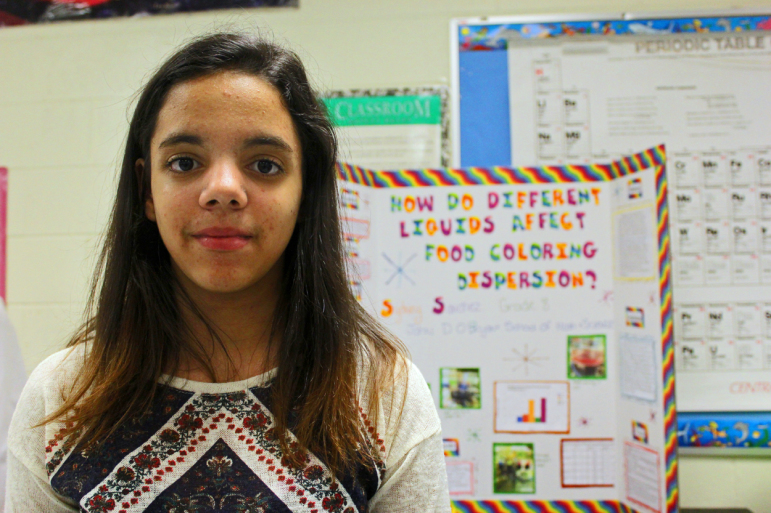
Sydney Sanchez is an eighth grade student who emigrated from the Dominican Republic when she was 5 years old. She's come a long way since she first arrived in the U.S.
"I had to learn English, I had to go to school with people I didn't even know and didn't understand me. So it was really hard for me," Sanchez said. "Now I'm out of [English as a second language classes] and I accomplished that goal of defeating the English language."
Sanchez's science fair project focuses on how different liquids affect food coloring dispersion.
"I use water, milk, ginger ale, vinegar and oil," Sanchez said. "My hypothesis was that the water would take less amount of time because [food coloring] is a water based liquid and I thought that the oil would take a longer time because it's a thicker liquid that has more density than the others."
Through her experiments, Sanchez proved her hypothesis incorrect. The milk took the longest amount of time and the vinegar the least -- and she says she's learned from the experience.
"I think that the milk took the longest amount of time because of an error that I made, which was that the milk was cold and not at room temperature," Sanchez said. "And I think that the vinegar took the least amount of time because it's very acidic, so maybe the acidity just took over the food coloring and absorbed it all."
Her project was inspired from a deeply personal place -- the eighth grade student loves to bake.
"After this experiment I really took on the food coloring power and used it on many things. It was really fun," she said. "I baked some cookies and I actually used the food coloring to add colors and rainbows and tie-dyes."
Luminol Illuminates Knowledge
Although recent data suggests that, compared to female students, male students are over three times more likely to be interested in STEM subjects, the O'Bryant school is sending multiple teams of girls to compete at the Citywide Science Fair.
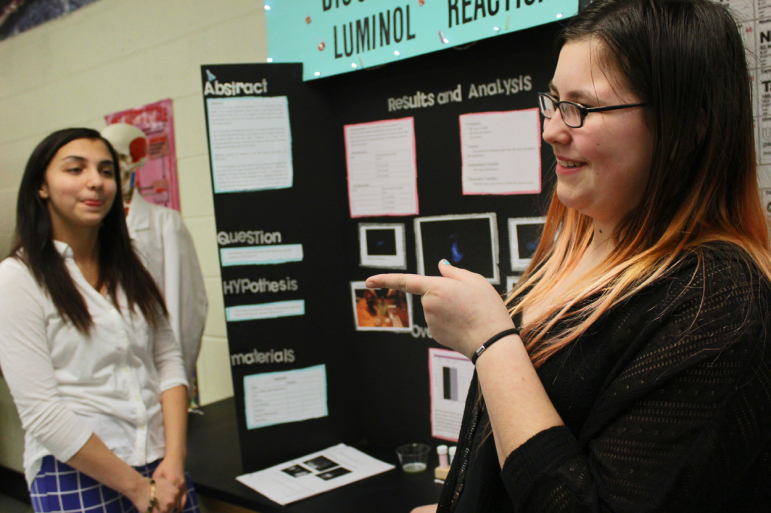
Cassidy Wright and Angelina Cancel make up one of those teams. The eighth grade best friends do everything together. It only made sense, they say, to team up for their science fair project, which was inspired by some of Wright's favorite TV shows.
"You may have seen police investigators or people in scenes, like in 'NCIS' or in 'Law & Order,' and they, like, are spraying the crime scene with something -- a liquid that comes up blue if there's any evidence," Wright said. "This liquid is called luminol."
Luminol is a chemical that glows a fluorescent blue when mixed with the appropriate oxidizing agent.
For their project, the girls are testing how the temperature of water, an oxidizing agent, can affect the speed of the light reaction. The students placed small scoops of luminol, a sodium mixture and copper sulfate into separate cups of water at different temperatures.
"When we put the luminol into the hot water, the hot water reaction was quicker than the cold reaction," Cancel said.
Although the students say they are not interested in careers that are directly related to science -- Wright hopes to be a detective and Cancel plans to be a professional wrestler -- the duo say that they can both apply what they've learned in science class to those jobs. For Wright it's her experience with luminol, and for Cancel it's knowledge of the body.
"Based on my knowledge from science class, for instance, when and if I become a wrestler, if I get injured I'll know how," Cancel said, gesturing to the classroom's skeleton.
'Science Isn't Just About One Day'
Northeastern University's Center for STEM Education runs numerous programs to engage students from elementary through high school in STEM learning. The center hosts science-related field trips, offers free summer programs and helps to organize the Citywide Science Fair.
On Monday, the fair organizers at the Center for STEM were in the midst of preparations.
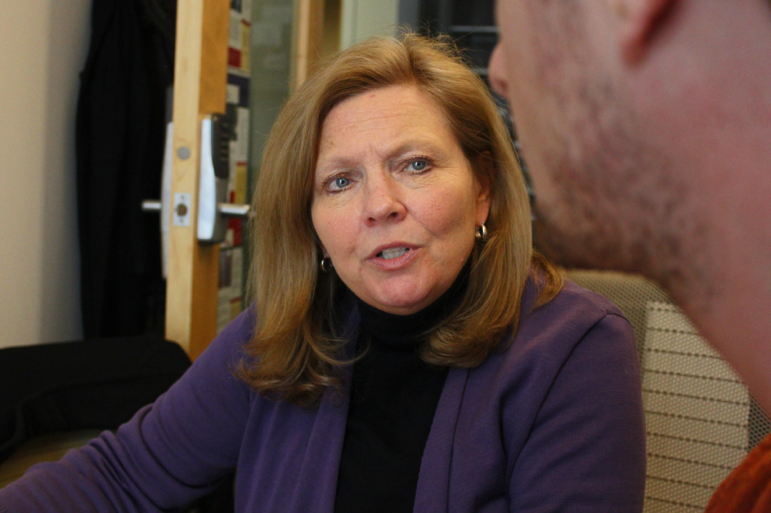
"This week, clearly in terms of preparation, are all of the little details of what judges are gonna judge, which particular projects based on their expertise," said Claire Duggan, director for programs and operations at the Center for STEM Education.
Duggan and colleagues have been busy reviewing judges, coordinating prize winnings and organizing the numerous science activities present at the fair.
Daniel Sullivan, a Northeastern graduate student studying urban and regional policy, is a program coordinator at the center. He is one of roughly 30 Northeastern students, both graduate and undergraduate, working to put together the fair. He has participated in the organizing of the fair since he was an undergraduate.
Sullivan is excited about the prospects that the fair and STEM education can give students.
"A lot of the students that are attending and participating in the science fair are already predisposed to STEM subjects," Sullivan said. "You just have to give them some of the resources to allow them to explore themselves, to just kind of open up some of those doorways and allow them to choose which ones they want to go through."
Duggan agrees. She says the fair is about appreciating the hard work of students and recognizing prizewinners, as much as it is about ensuring students have supports to continue following their passions "for the long haul."
During the fair's lunch hour, students will have an opportunity to learn about job opportunities, and summer and school year STEM-related opportunities.
"We do like to ensure that every student that participates in the fair does walk away with a next step to support their science or engineering interest," Duggan said. "What all of the partners are really looking to do is to say, 'Science isn’t just about one day.'"
The 69th annual Boston Citywide Science Fair takes place at Northeastern University's Cabot Building on Saturday from 8 a.m. to 4:45 p.m. The fair is open to the public from 1:30 to 2:45 p.m.
Related:
- A profile of last year's Citywide Science Fair champion
- Northestern University Center For STEM Education's 69th Annual Boston Citywide Science Fair Website
- Boston Public Schools' Citywide Science Fair Website
- Radio Boston: Boston Latin 9th Grader Awarded $75,000 For Genetic Detection Tool
Correction: An earlier version of this story incorrectly stated who from Northeastern University's Center for STEM Education reviewed judges, coordinated prize winnings and worked to organize science fair activities. Claire Duggan and colleagues were in charge of this effort. We regret the error.