Recycled Shipping Container Is Home To Student Farming
BOSTON -- On the lawn behind Boston Latin School lies a recycled metal shipping container that contains cargo, perhaps, unlike anything it carried in its former life.
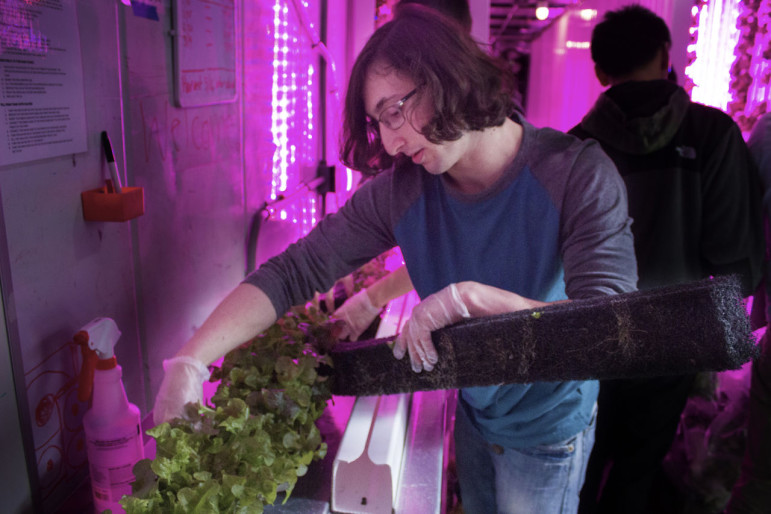
Inside of the 320-square-foot container's insulated walls, lays a low-energy farm in which students grow fresh produce year-round. The freight farm -- named after the shipping container it resides in -- is operated by students who dedicate time to the farm during study halls and after school.
"What the freight farm is, is a hydroponic farm which uses no soil," says Taran Wise, a senior. "So it circulates water through the farm, mixed with nutrients."
Over the past two months Boston Latin School students have worked almost daily to cultivate lettuce, raising and maintaining the plants from seed to harvest.
A 'Trial And Error' Process
"It spends one week in the germination tray, after that it's moved up to the trough where it spends two weeks," says Tim Hird-Devlin, a senior, indicating a plastic trough budding with green seedlings. "After that it will spend between three weeks to a month in the towers."
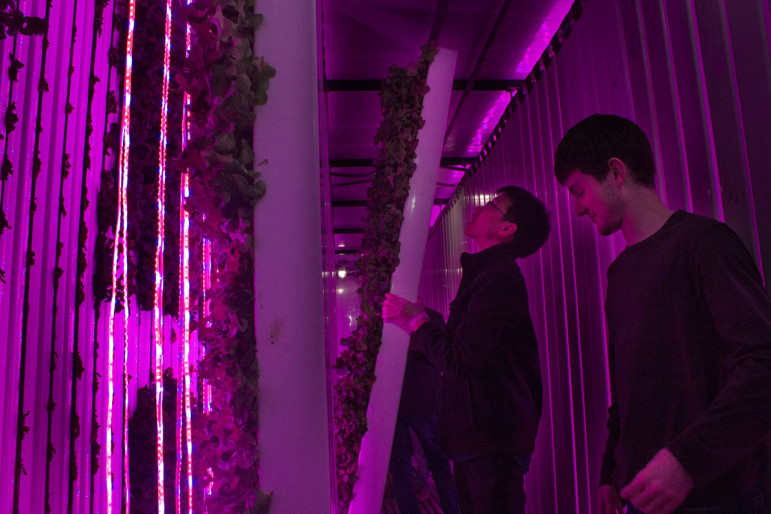
Aligned in four rows that stretch through most of the container are 224 removable towers. On average, 20 plants grow out of each tower. The towers are connected to the farm's water system which streams water down vertically.
"You can see that the water collects here and it gets brought back into the tank through a re-uptake pump," says Wise, pointing to a trough that collects water beneath the towers. "So we're cycling the water through the whole system."
Instead of dirt, plants in the towers grow in a plastic mesh made out of recycled water bottles. Sustainability and environmental efficiency are central themes to the work that students do.
"The end goal would be to be able to use the crops we have in school meals. To be able to grow it right here about 15 feet away from school is about the definition of locally sourced," says Hird-Devlin. "It is as environmentally efficient as possible."
The hands-on nature of the farm gives students an opportunity to learn and apply science concepts beyond the subjects covered in their classrooms.
"My period that I come to come out is definitely my favorite period of the day. I can come in here. I can just focus on the work," says Hird-Devlin. "I just come out and do it without having to worry about grades or anything else inside the school."
This winter, students found a crop of their plants submerged in water and drowned. That experience did not discourage students. Instead, it prompted them to figure out the problem -- the re-uptake pump was broken -- and work past it with a brand new crop.
"We're making everything in here. We're learning it from the ground up. This is new to us, as it is to the whole community," says Wise. "We're not being taught by a teacher either. This is trial and error."
Farm Origins
In 2007, eighth grade U.S. History teacher Cate Arnold taught her students a lesson she teaches every year: analyzing how the media covers a current issue. She showed students Al Gore's "An Inconvenient Truth" and asked them to compare it to current media.
"They went to look at how the media was covering climate change and said, 'This is terrible. There's nothing in the news about climate change,'" says Arnold. "So they decided they needed to start a club."
That club became Boston Latin School's Youth Climate Action Network (YouthCAN). Their mission: take action to address problems of climate change and promote education for sustainability.
In 2013, YouthCAN won a "school makeover" competition from Global Green USA, an environmental nonprofit, to improve the environmental efficiency and overall healthiness of their building. The award included a $75,000 grant for green technologies and $65,000 worth of technical support.
They used the money for various "green" projects -- including the purchase of the $76,000 hydroponic farm from Freight Farms, the company that specializes in equipping and distributing shipping-containers-turned-hydroponic-farms.
According to Freight Farm representatives, Boston Latin School is the first and only high school to have made such a purchase.
"We just thought that was a great way to have a high visibility conversation in a big community about sustainability in general through food," says Arnold.
This school year, the farm has been overseen by a core team of about 10 students, both YouthCAN members and non-members.
Consistent Growing Conditions
An initial look at the enclosed farm might make an observer wonder how plants can grow without a crucial ingredient: sunlight.
Instead of sun, the farm is equipped with high-efficiency red and blue LED lighting that mimics the hues of sunlight. The lights, which give off a serene pink glow, automatically cycle to simulate periods of day and night for the plants. The consistency of the lights and the water means that every day is a day with ideal growing conditions.
"There are no cloudy days, there are no sudden rainstorms that affect your yields," says Phil Cuddeback, farm manager at Freight Farms. Since the farm was introduced last school year, Cuddeback has been training students to use the farm.
Due to the farm's consistent growing conditions, Cuddeback says that the 320-square-foot farm can actually yield an acre's worth of food in a year.
"It's also how we optimize the space in the farm, growing vertically like that," says Cuddeback. "We're able to fit a lot more in that space than you can on a traditional farm outside."
Plus, the recyclable material used instead of soil gives an added time bonus.
"When you're outside you have to allow time for the soil to rest and then build up nutrients again, but here it's just kind of rapid-fire," says Cuddeback.
Harvesting Toward A Sustainable Future
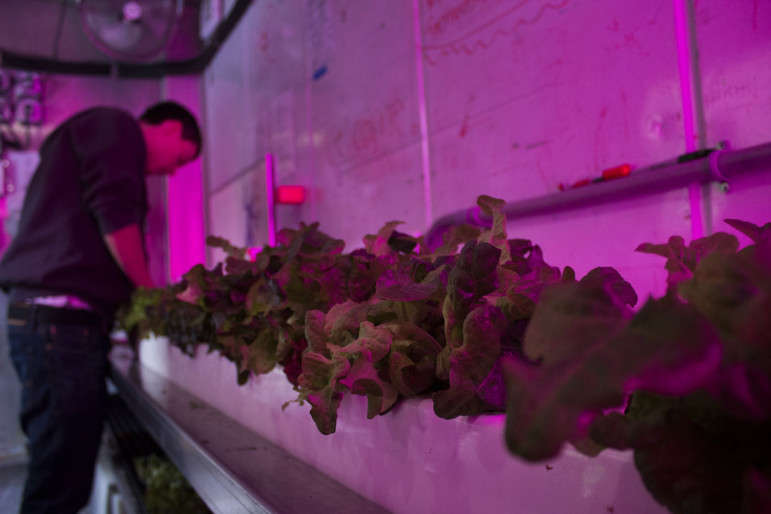
Students, at the harvesting phase of their freight farm crop, plan to give the lettuce away to teachers and students. Their goal is to eventually introduce their produce into school meals and create a system to sell shares of produce to community members.
Amy Wong, a junior, helped create a website for the work students are doing with the freight farm.
"We're trying to make people more aware that we're doing this," says Wong. "We want them to buy our produce later on. We want them to know what a sustainable lifestyle is."
For now, harvested crops are heading home with Boston Latin School students, teachers and faculty. Extras will be sent to support the work of local food pantries.