7 Things To Know About The Potential State Takeover Of Holyoke Schools

On Tuesday, Massachusetts' Board of Elementary and Secondary Education may vote whether or not to take over Holyoke Public Schools and place it under receivership.
At March's board meeting, Mitchell Chester, commissioner of elementary and secondary education, proposed the move. Chester cited pervasive problems and consistent underperformance in the district. Earlier this month, he formally recommended the district be placed under receivership.
Under state receivership, the commissioner and a state-named receiver would develop a district turn-around plan to enhance academic progress in the district. The district would remain under receivership until it has improved to the point that the designation of "chronically underperforming" can be removed.
As a part of the plan, the receiver would have authority to hire or fire staff, regardless of union contracts.
Here are seven things to know about the potential receivership.
1. Commissioner Chester recommended the district be placed under receivership. Now, the board of education needs to vote on it.
The proposal to declare Holyoke Public Schools a "'chronically under-performing' (Level 5) district" came at last month's meeting of the Board of Elementary and Secondary Education. The board will discuss the possibility at its April 28 meeting and may choose to vote on the matter at that time or at a later date.
Under state law, Level 5 districts are placed under receivership.
In a recent memo, Chester wrote that "low academic performance and high dropout rates continue to characterize the Holyoke Public Schools." The district's on-time graduation rate is the lowest of any K-12 district in the state and the dropout rate is the second-highest in the state.
Holyoke student performance is considerably below statewide student performance, with a majority of students performing below grade level math and English language arts (ELA). Only 15 percent of third-grade students are reading at grade level.
The commissioner clearly backs receivership, as do others. The editorial board of The Boston Globe says that Holyoke schools have the best chance at success with a state takeover. The Massachusetts Business Alliance For Education tweeted its agreement.
2. Many people are not happy with the prospect of state takeover and receivership.
There has been a strong opposition from teachers, parents and students to the possibility of district receivership, instead preferring to maintain local control.
The Massachusetts Teachers Association has been quite vocal about their desire for a locally created vision and plan. The Holyoke Teachers Association has vowed to organize the community in order to oppose the takeover.
Even students have taken matters into their own hands. In response to the threat of receivership, students at Holyoke High School staged a walkout to protest the possibility. Students marched from the high school to City Hall, met with Mayor Alex Morse and protested outside the district's central office.
Superintendent of Holyoke Schools Sergio Paez said in January that receivership could be "devastating" to programs recently implemented into the district. Programs include a dual-language school program and Advanced Placement classes at the high school.
Recently however, he has changed his tune about receivership, saying he could support receivership -- if he is named receiver.
3. The district has seen some improvement. Just not enough.
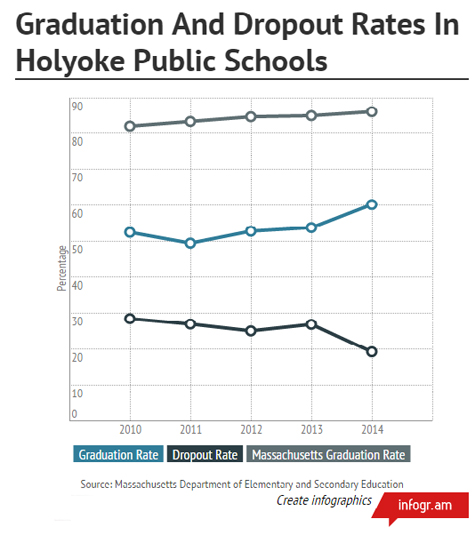
Another reason for much of the opposition is that Holyoke has seen some improvement in recent years, just not enough or fast enough for state education officials.
For instance, the graduation rate climbed from 49.5 percent in 2011 to 60.2 percent in 2014, but the new number is still the worst graduation rate in the state. Similarly, the dropout rate has fallen but is still the second highest dropout rate in Massachusetts, following Springfield.
Other improvements include additional professional development training for teachers and about 100 new pre-K seats. Despite the improvements, a state review of Holyoke Public Schools released this year found troubling achievement rates and that district-determined curricula that meets state standards does not always make it into the classroom.
4. State officials are already interviewing possible receivers.
There has yet to be a vote on receivership, but Commissioner Chester is actively pursuing potential receivers.
In the same memo cited above, Chester said he has been meeting with potential receivers and pursuing references to determine the best match for Holyoke receivership.
5. Two factors may be affecting measures of achievement: English-language learners and poverty.
Nearly half of Holyoke students do not speak English as a first language and nearly 30 percent are English-language learners. Standardized tests, which have been a major factor in determining achievement in Holyoke, present a number of challenges for English-language learners (ELLs).
Research suggests that although such tests intend to assess subject-area knowledge, many ELLs can find themselves required to take assessments before their English language skills are developed enough to comprehend the tests.
Eighty-five percent of Holyoke students come from low-income households. Recent research shows that poverty may be the largest factor that affects academic achievement and likelihood of dropping out of school.
While the 65-page review of Holyoke schools released this year does take English-language learners into account, nowhere does it specifically address the effects of poverty on student achievement.

6. Other state receiverships have shown fairly positive early results.
Only one other public school system is currently under state control: the Lawrence Public Schools.
The state took over the Lawrence school district -- a district with very similar demographics to Holyoke -- in 2011 after numerous superintendents were fired after allegations of misconduct, poor graduation rates and dismal academic proficiency.
From CommonWealth Magazine:
Rather than a fixed turnaround regimen for all 30 schools overseen by a take-no-prisoners new superintendent, the plan called for responsibility for improving schools to rest with principals and teachers, who were given broad authority over curriculum and the structure of their school’s schedule.
The state-appointed receiver, Jeff Riley, a former Boston school principal and administrator, brought in organizations that have run successful charter schools to operate two schools within the Lawrence system. A third school is being run by a Boston-based nonprofit that operates two schools within the Boston district as part of turnaround efforts there. Meanwhile, the teachers union in Lawrence, which opposed the state takeover, was put in charge of overseeing one of the city’s elementary schools.
With the district's less-than-typical approach, some early gains have been reported.
By 2014, the percentage of students scoring proficient on state exams increased dramatically in math, from 28 to 41 percent, and slightly in English language arts, 41 to 44 percent. Graduation rates have increased and the dropout rate has fallen.
While as a receiver Riley had the option to let teachers go regardless of contract, he avoided mass firings within the district.
7. So what's next?
A special meeting for public comment will be held Monday April 27, 2015 from 4 to 7 p.m. at the Holyoke War Memorial.
The Board of Elementary and Secondary Education meets Tuesday April 28, 2015 at 11:15 a.m. to discuss and possibly vote on receivership.