Driverless Cars Accelerate Learning At Cambridge Science Fest
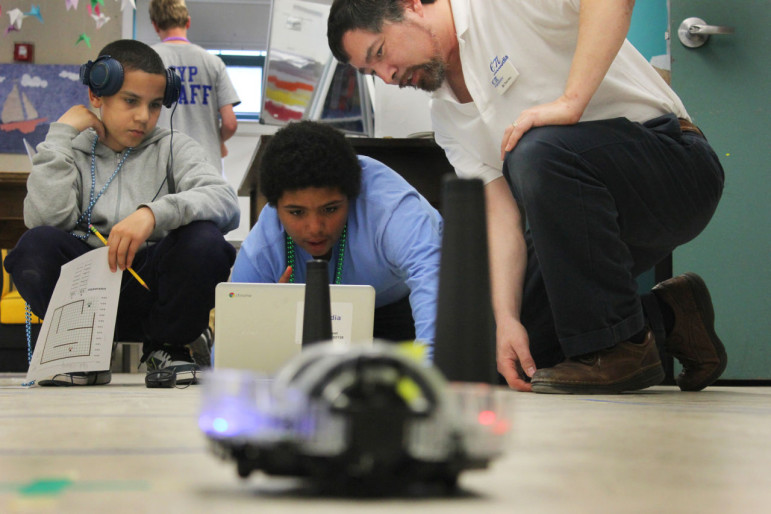
CAMBRIDGE, Mass. -- They call it the car of the future, but its turns aren't quite wide enough for this present-day road. One look at the driver's resigned face confirms that disaster is imminent. A sigh escapes from pursed lips.
The car crashes.
Despite the collision, there are no flames to quell and no police to call. Instead, smiling, fourth grader Daniel Hargrove walks over to the makeshift course in the middle of the room. He picks up the driverless robotic vehicle he programmed and scoops up the black plastic cone knocked over by the car.
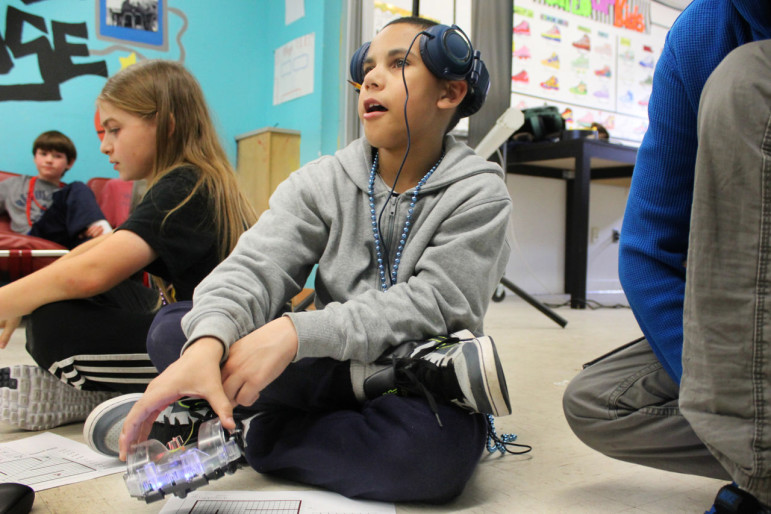
It's school vacation week, but learning certainly has not come to a halt at the Gately Youth Center. Eleven lively boys from fourth through seventh grades program and test small robotic vehicles equipped with real-time motion technology.
The workshop's goal is to empower students through technology and computer programming at a young age. It is one of about 160 science, technology, engineering, art and math (STEAM) happenings that have blossomed across Cambridge this week as part of the annual Cambridge Science Festival.
"Science is everywhere, science is for everyone, and science is in everything that we do," says P.A. d’Arbeloff, the festival’s director. "It's our responsibility to put it out there on display. To let people understand and value the wonderful work that's going on all around them."
The 10-day festival, sponsored largely by Massachusetts Institute of Technology and the Biogen Foundation, costs roughly $500,000 to put on and organizers expect to reach around 60,000 people. WBUR is a media sponsor.
In order to celebrate and harness the significant STEAM research and work happening in the Boston region, d'Arbeloff and festival organizers put out a call for entries for local groups to participate and host various science-related workshops, like the motion physics workshop underway in the basement of the Gately Youth Center.
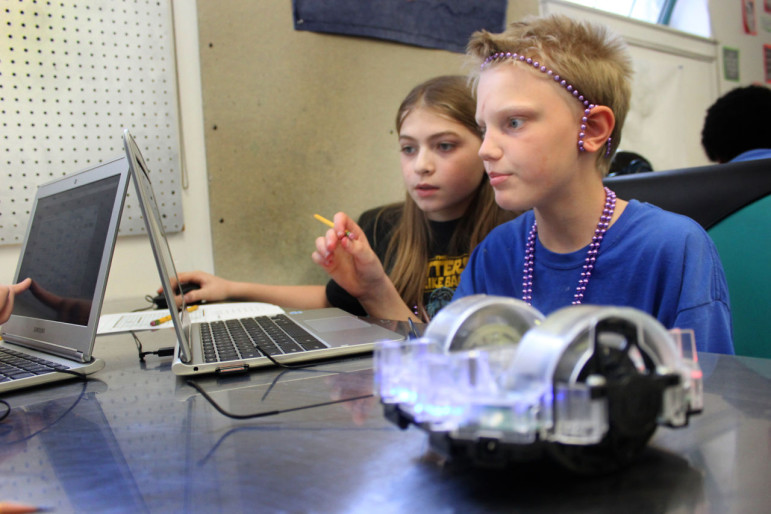
Beneath Christmas lights pinned to brightly painted blue walls, the 11 boys excitedly tap away at laptops. While much too young to legally sit behind the wheel in any state, today the rambunctious elementary and middle school students learn to operate vehicles that could be the norm on the roads some day -- robotic, self-driving cars.
Flitting between tables is Tom Hsu, president and co-founder of Ergopedia, the Cambridge-based company hosting the day's workshop as part of the Cambridge Science Festival.
Hsu gives the boys guidance as they attempt to program their ErgoBots -- miniature robotic cars akin to smaller versions of the Google Self-Driving car -- to navigate a course that he has set up. They need to determine how fast the vehicle should go, for how long and at what degrees the vehicle should turn in order to complete the course.
The idea behind the workshop is to introduce students to technologies and engineering skills in a way that students can immediately see the reasoning behind it.
"We're teaching kids how to do robotics, how to take science and math -- abstract ideas like speed and motion and Xs and Ys -- and make them realistic," says Hsu. "Part of what we want to get them excited about, is that there's a reason we're teaching you this and you know what? You can do it."
The "you can do it" mentality is a pervasive part of what Ergopedia does both in workshops and in middle school, high school and college classrooms. With an eye on using technology to invigorate learning, Ergopedia designs curricula, textbooks and robots for students in a manner they say is accessible.
"Einstein said, 'If you can't explain it simply, then you don't know it well enough,'" says Manos Chaniotakis, CEO and co-founder of Ergopedia. "Our goal is to be able to explain the concepts simply for the teachers and the students that engage with it."
Research indicates that kids who experience science, technology, engineering and math (STEM) through hands-on learning are the best equipped develop an understanding of STEM concepts -- concepts that some economists say are of crucial importance to the future of the American economy.
In 2012, a federal economic report projected that the U.S. needed approximately 1 million more STEM professionals in the next decade in order to retain preeminence in science and technology.
Since then, the number of college graduates with STEM degrees and number of STEM jobs have increased, according to a report from the Government Accountability Office. However, it is difficult to determine if the increase in STEM graduates is aligned with workforce needs, in part because demand for STEM workers fluctuates depending on the specific field.
For Hsu and Chaniotakis, the future of STEM fields relies on reaching students like fourth grade Daniel Hargrove now, when they are young.
After seeing his car crash into the black cone, Hargrove and classroom partner Jayden Brothers adjust their program. They change the speed the car needs to travel.
This time, as Hargrove watches the programmed vehicle approach the cone, no sigh escapes his lips. Instead, a yelp of joy.
The car makes it.
--
The 2015 Cambridge Science Festival runs through April 26, 2015. More information and full schedule are available at http://www.cambridgesciencefestival.org/