'Law Day' Gets Boston Students Thinking About Civics
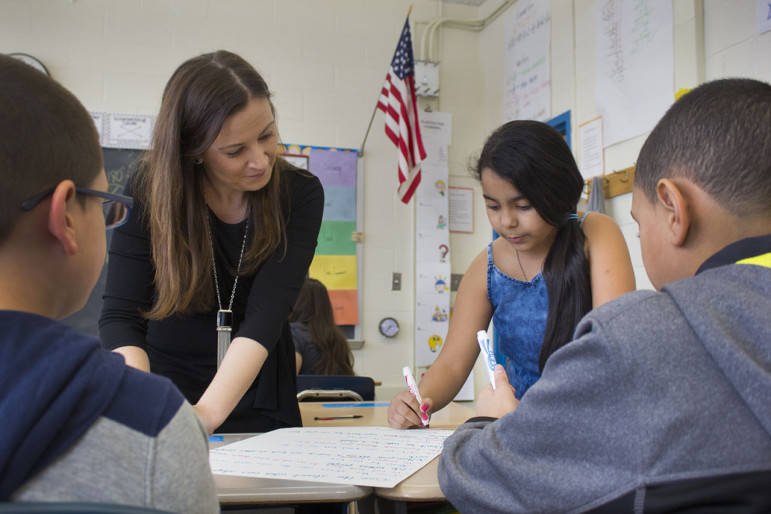
"Laws are like adult versions of the rules," Emily Hodge, a white collar criminal defense lawyer, tells the attentive students. "What're we're going to do today is to figure out why we have rules."
On most days, Hodge, a lawyer with Boston-based law firm Choate Hall and Stewart LLP, presents to the U.S. Attorney's Office. On this recent Wednesday, however, she holds court with a different audience -- a fourth grade classroom at the Manassah E. Bradley Elementary School in East Boston.
She is one of 77 lawyers and judges visiting Boston public schools this week. The goal: Teach students about the law and give students the chance to nitpick their brains.
"Part of what we can do for our students is really to prepare them to be participating, educated citizens," says Hodge. "When you can teach kids early on to appreciate and understand the basic ideas that underlie our justice system ... they can gain a sense that it's something that they want to participate in."
Hand-drawn posters bursting with mathematics equations and formulas cover white concrete walls and bright windows in the fourth grade classroom, but at the moment, students focus on the guidelines that shape their own lives.
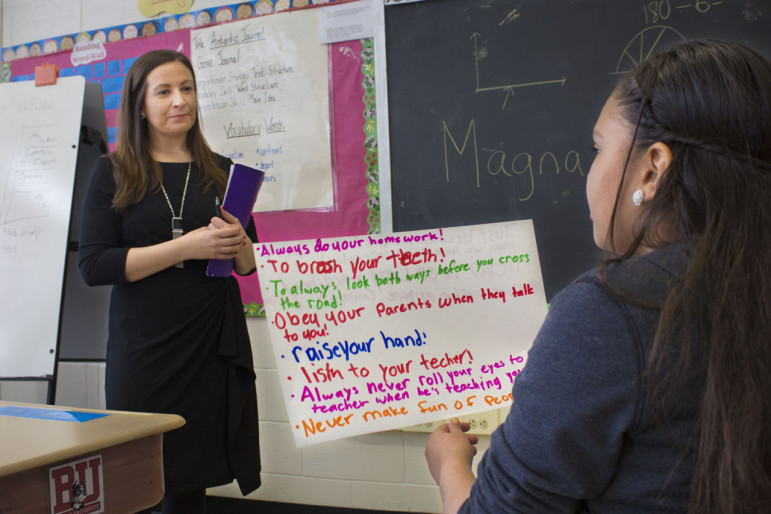
Divided into groups of three or four, the classroom is abuzz with chatter as Hodge has students list the rules they must follow.
"One of my rules is to look both ways before you cross the road," Camilla Beharry tells the two other girls huddled around her desk. "So you don't get run over or anything."
"One of my rules is that I always have to be doing my homework or else I would get in trouble if I didn't do it," replies classmate Katherine Coto.
Lawyer Hodge moves fluidly between groups, holding students' attentions with a charismatic air as she assists them with the activity.
After students list their rules, Hodge discusses their importance, focusing on the order and safety that they may bring to students' lives.
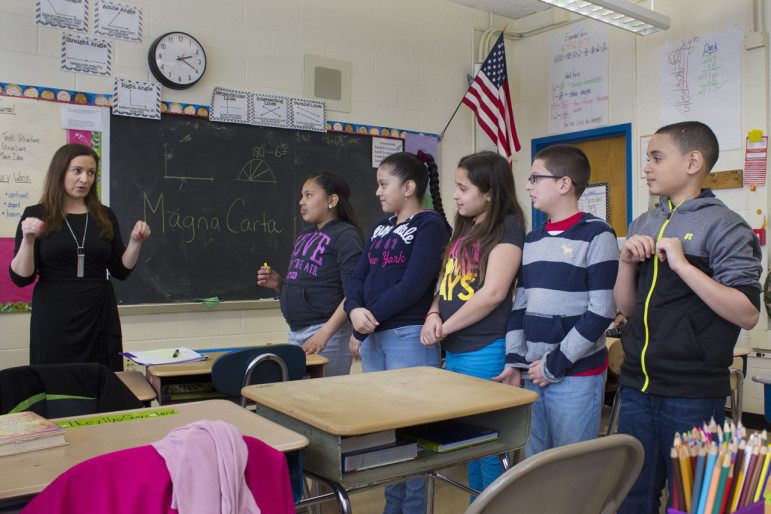
Her visit is a part of Boston Bar Association's (BBA) week-long "Law Day in the Schools" activities. To recognize what many term Law Day on May 1, members of the association will teach over 1,000 students in seven different schools over the course of a week.
May 1 is a day that holds many meanings. Internationally it is recognized as May Day or International Workers Day, a day to celebrate the contributions of laborers and workers. Often, the day becomes a rallying point to recognize worker struggles in the fight for better wages or working conditions.
To others, it serves as Law Day, a day to reflect on the role of law. In 1958, President Dwight D. Eisenhower proclaimed May 1 to be Law Day in the U.S.
Like Earth Day, Law Day in not a government holiday. Instead, it is generally recognized by local bar associations in the form of events, like the one at the Bradley elementary school. Since 1986 the BBA has hosted annual activities in Boston schools.
"Teaching the students of Boston Public Schools not only about a particular topic in the law, but to talk to them about what it means to be a lawyer, how to become a lawyer and about what lawyers do is a great connection," says Sonia Shah, public service manager at Boston Bar Association.
If students get one takeaway, Shah knows what she wants that to be.
"Lawyers are regular people," she says.
At a time when nearly half of millennials believe that the U.S. justice system is unfair, the BBA hopes to encourage younger students to become familiar with that system.
They are not alone in their hopes. Fourth grade teacher Michael Wilson has taken numerous efforts to acquaint his students with civics and the law, an area he is not shy to admit he is not an expert in.
"You always want to expose kids to as much knowledge as you can and for someone to come on besides me and teach them, to have someone else come in, is a great way to learn," says Wilson. "We just want to give them an idea of what's out there."
Wilson is a teacher who clearly has an eye on his students futures. In his classroom, the desks are divided into rows, each named after area colleges -- Harvard, Northeastern, Boston University and Boston College -- to create an "everybody can go to college" mindset.
Wilson says that it was contact with a great teacher that made him know he wanted to teach. He hopes giving students contact with other professionals may be a great way to inspire them, as well.
Alongside the curriculum taught by Wilson, every Tuesday since February students from Harvard Law School come in to teach classes about the workings of the government.
Their civic knowledge shines through when given the chance to ask Hodge questions.
They wonder whether Hodge felt scared at law school, if a lawyer can have another lawyer defend them, if a lawyer should should still defend someone even if they're guilty and what happens if a lawyer loses a case.
Although more focused on end of year exams than any bar exams, students in the fourth grade classroom have high civic hopes.
When asked what she wants to be when she grows up, student Camilla Beharry doesn't hesitate.
"Either president or a lawyer," Beharry says. "Because I want to help people."