5 Questions With Citizen Schools Co-Founder Eric Schwarz
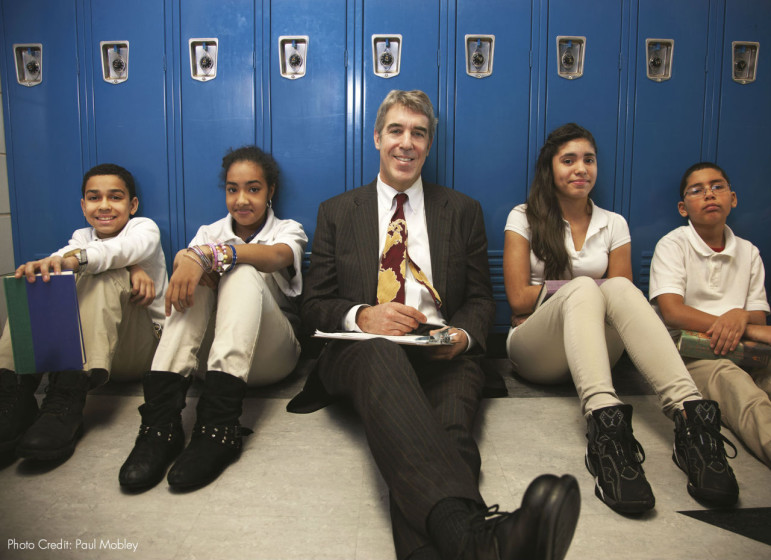
BOSTON -- In order to battle achievement and opportunity gaps between lower and upper-income students, Citizen Schools chose longer learning days as its weapons of choice.
For two decades, the Boston-based non-profit organization has partnered with schools across the country to offer an extended learning day program for low-income middle school students. Their extended learning day program is led by volunteer teachers from various professions and supported by Citizen Schools teaching fellows.
Today, Citizen Schools partners with 29 schools across the nation. Six are located in Massachusetts.
Eric Schwarz, co-founder and former CEO of Citizen Schools, says more time at school can replace the activities that upper income students often benefit from -- robotics camp, academic tutoring, piano lessons, after school activities and more.
Last week, Schwarz sat down with Learning Lab to talk about Citizen Schools in its 20th year, the benefit of an extended learning day and the challenges the organization has faced.
An edited version of that conversation follows:
Citizen Schools is in its 20th year. That's quite a run. How has the mindset of the organization evolved since the beginning?
There are a lot of things that have been consistent from the beginning. Still today we're trying to bring opportunity to all kids, but really focus on the best that upper-income kids get access to in the after school and summer hours, and bring those same opportunities to all kids. We've always had a vision of engaging citizens in the classroom. We've reached out to engineers from Google, architects, lawyers, business people to get them involved in learning beyond the regular hours and the classroom's tradition walls.
What's evolved, I think, is how deep the work is and how focused the academic work is. Also our work on policy.
We started as a couple-days-a-week after school program and increasingly we're working with schools to serve every kid in the school for three hours a day, 4 or 5 days a week. We started looking to inspire kids, but now increasingly we're looking to inspire kids but also build their math scores, lift up their academic performance, get them to college at higher rates.
We're playing a bigger leadership role in trying to influence public policy around the whole area of opportunity and expanded learning time. We have been part of a coalition in Washington, D.C., that is trying to develop more federal funding to expand the learning day.
It's kind of crazy that in the 21st century that kids are only in school six to seven hours a day, 180 days out of the year. We know that, as Malcolm Gladwell said, it takes 10,000 hours of practice to get great at anything. Upper income kids are getting that through a combination of school and all kinds of after school activities, tutoring and parental support.
So, if we want to have any prayer of closing an achievement gap we need to give a much longer, interesting learning day.
A large focus of Citizen Schools is on that extended learning time, specifically with middle school students. Why do we need more time and why focus on that age group?
The point of adding the time is that kids aren't learning nearly enough in the time that they're in school. Graduation rates and the gap between upper and lower income kids has grown substantially compared to two generations ago. The gap in math skills and reading skills has grown between upper and lower-income kids. The current system is just not working. We're leaving too much talent on the sidelines and that's just not a good thing for the U.S. economy, that's not a good thing for social justice, and not consistent with the American brand.
So a longer learning day is one of the ideas, but also a more engaging learning day that's more hands-on, more real world learning.
Middle school, I think, is the most broken part of the educational pipeline. There's challenges at every step of the way and no one age group is sort of a silver bullet -- you can't just do kindergarten well or just do high school well. Middle school is the point where the U.S. falls way behind other industrialized countries, it's the point where kids are pushing away their parents and need more mentors and help from the outside. And it's an age that really responds well to Citizen Schools message of "go make things" -- work with architects to redesign your school, work with business people to start a T-shirt business, or work with engineers to work with engineers build a robot or help launch a rocket.
How do you respond to the criticism that programs like Citizen Schools may send under-prepared teachers to the most high-needs areas?
I think one way to respond to it is to just look at the data. Citizen Schools has a number of million dollar, high quality evaluations that we've done that show that we're closing the achievement gap on the MCAS, that we're closing the achievement gap on finishing high school on time, we're closing the achievement gap on kids moving on to four-year colleges. We're adding months and months of extra learning for every year that kids are in the program.
I think in the future we need to think differently about the talent pipeline for schools. We work very closely with teachers and we're very supportive of teachers, that's not true of all education reforms.
If you talk to teachers they'll say, "Hey, Citizen Schools actually allows me to do my job and provides support for me to do my job."
The fact that Citizen Schools has some young educators, many of whom go on to be great full time teachers, who can do homework with kids, who can provide some extra academic coaching, extra practice and can work with professionals in the community, that's transformative and not what regular teachers can do very easily.
So it's not about replacing teachers it's about augmenting and supporting them.
As an outside non-profit teaming up with existing schools and school systems, what have been some of the biggest, most unexpected challenges?
I think a lot of the challenge has just been the pace of change in public schools. You'll get a great working relationship with a school principal and then they leave. You get a great working relationship with a school superintendent and then they leave. So that I think is challenging.
I also think it's very hard for people generally, for human beings, to think outside of the box. We're very conditioned to do things the way we did them yesterday. So when you have a vision that maybe school could be longer but also more fun, more interesting and different, that is counter-intuitive. So it's struck me over the years how challenging it sometimes is for folks to embrace counter-intuitive ideas.
Imagine Citizen Schools at its 25th anniversary, five years from now. What do you hope the organization will look like?
I think, hopefully, we'll be a lot bigger. We'll be in more communities, we'll be in more schools serving more students. I'd like to see our evidence-base continue to grow, so we have stronger and stronger evidence that this kind of program not only makes sense, and sounds good, but there's more proof of concept.
I'd like also to really see this become the new normal and that's going to happen from policy change and other organizations saying we want to do similar things. We also want to partner with schools to give kids a much longer day, a much more interesting day and a much more effective day.
Hopefully a whole movement that grows out of the best of after school and the best of extended learning to really make what Citizen Schools has piloted the "new normal" in middle school education and K-12 education.