Cambridge Rindge And Latin Diversifies -- With Private-School Students
By Sally Jacobs
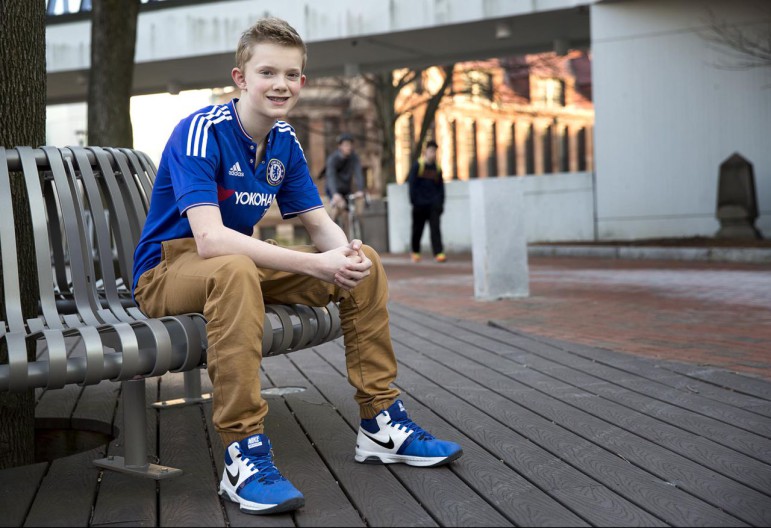
Levi Herron, a lanky blond eighth-grader, has a difficult choice to make in the next few weeks.
Herron, who has attended private school all his life, needs to decide where he will go to high school in the fall. His father would like him to go to the Pomfret School, a boarding school in Connecticut that he and many family members attended. But Herron likes another school, too: the city’s public high school, the Cambridge Rindge and Latin School. It’s just a few blocks from his home.
“If I had to make the choice today, I think I would definitely choose Rindge,” said Herron, who attends the St. Peter School in Cambridge. “I think it's just a really unique experience that could mean a lot to me throughout my life and really put me on a good path."
Herron is one of an increasing number of independent- and parochial-school students turning to the public high school. Already, 60 private school students have signed up to attend Rindge in fall 2016, more than 13 percent of the average freshman class of 450. That’s up from just five in 2011 and 49 last year.
Administrators and school committee members say that the new students, most of whom are white, add to the school's famously diverse student body, in which more than 70 countries are represented. The school has about 60 percent students of color and 47 percent low-income students; 69 students are homeless.
Private-school students, many of whom are affluent, remain a minority. But Principal Damon Smith says their rising numbers present a challenge.
“As those students come in from outside of our system, it changes the demographic, and it's our work as a school to make sure that we are meeting the needs of every individual student,” Smith said. “We think we can do that.”
For the school of 1,860 students, the development comes after a decade of change. Thirteen years ago, Rindge was put on probation, partly because of concerns about its curriculum and leadership. Since then, the school has revamped its academic program and completed sweeping building renovations.
Today, it offers some of the latest classroom technology, a student-teacher ratio of 10 to 1 -- lower than the state average -- and award-winning programs in arts and sports. And it spends $25,420 per student, part of the reason Cambridge ranks second in per-capita spending among school districts statewide.
All that makes Rindge an attractive option for some families, driven by the economy to seek affordable alternatives to private school. For other students, the idea that public school is edgier than the protective environment of private schools holds appeal.
“I wanted to get out of the bubble that private school puts you in,” explained junior Mihir Edulbehram, 17. Although Rindge is very different from his old school, Shady Hill, he says, it's been a very positive experience. At private school, “you're really sheltered from disobedience, or fights and drugs. To me, it's helpful to understand more what the real world is like.”
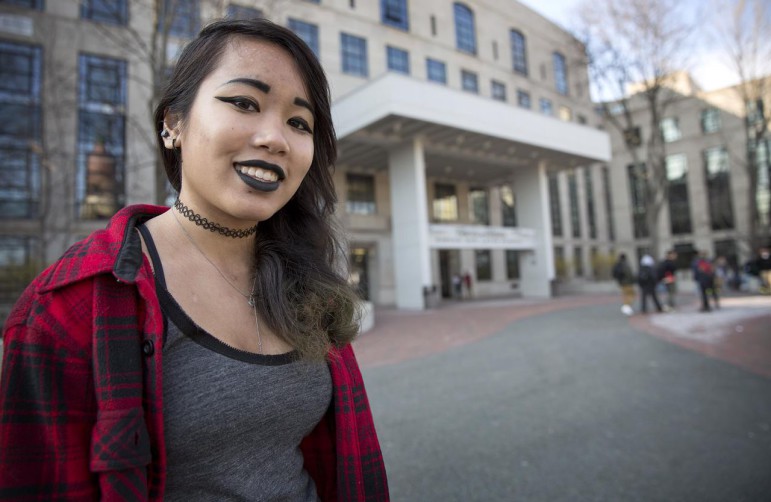
Still other parents say the great diversity of students at Rindge means the school offers a wider range of academic options. Maria Vetrano's 16-year-old daughter, Stella Privett, left a Cambridge private school last month to enroll at the school, also known as CRLS, partly for that reason.
“I don't think a private school can compete with all that CRLS has to offer,” said Vetrano. “At CRLS you may be spectacular at computer science and not so good in English, so you can take English at a lower level. CRLS is more accommodating than a private school, and it's able to embrace many types of learners.”
Rindge offers a host of vocational programs like biotechnology, culinary arts and automotive classes. But it also has a rigorous college prep program that includes 22 AP courses. It's partly this variety that is attracting students from private schools.
And the school has taken steps to reach out to them. Principal Smith says that a few years ago several families told him they wished they had known more about Rindge before private-school deadlines rolled around. In response, the school scheduled its information night and published its course catalog earlier in the year. School representatives have also gone to recruit on other campuses.
“We never went with the intention of, like, we are going to have a concentrated effort to bring more parochial-school and private-school families back to CRLS,” said Smith. “We just wanted to kind of express that, you know, we are a viable option. Take a look at us as well.”
One aspect of the school that is not detailed in its glossy blue and white catalog is common to many urban school systems: a persistent achievement gap. At Rindge, low-income students and some students of color do less well on the MCAS than their white and Asian classmates. In addition, many more white students take AP and honors classes: In 2013-14, for example, 54 percent of white students were enrolled in AP courses, while only 17 percent of black students and 22 percent of low-income students were.
Senior Amisi Nazaire-Hicks, who attended the independent Park School in Brookline, says she is often one of the few students of color in the AP classes she takes at Rindge, which also offers lower-level classes known as CP, or College Placement.
“If I walk down the hallways and I look into a class and see mostly students of color, mostly, like, black and Hispanic students, you'd assume it was a CP class,” said Nazaire-Hicks, who is Haitian and African-American. “I think private-school kids, not from their own fault, but coming into this school, they are taking honors and AP classes and, being generally white, are contributing to the quote-unquote segregation that has been happening in the school.”
Richard Harding, a Cambridge School Committee member and a Rindge alumnus, sees racial divisions that cause problems even after students graduate.
“In my opinion the school is so segregated, with so many kids of color and poor kids not taking the other classes, right, that something has to change in order to move the needle around student achievement and success in college,” said Harding.
Asked how the school intends to guard against further polarization as the number of white students increases, Superintendent Jeff Young said, “by being focused and intentional ... by continuing to raise the consciousness of our teachers and administrators around a diverse population.”
Principal Smith is developing several strategies he believes will help minimize the racial divide between class levels. Like many administrators, he believes students of color could excel in the more challenging classes but prefer to stick with their peer group in part to avoid harassment. His plan would encourage cohorts of students to join classes where their numbers are not proportional and would provide them with additional support.
“We're not immune to what happens outside in the world around microaggressions, stereotyped threats and all those particular issues,” said Smith. “We at least want the ... demographic representation in our honors and AP classes to look like the representation that we have in the school. We have some distance.”
In the meantime, students have other things to think about -- like where they’re going to school next year. Levi Herron plans to revisit his father's alma mater, as well as the high school. But the truth is he's already got his eye on the psychology and criminal justice courses in the Rindge catalog.
“I think I'd like to try a different kind of school than what I've experienced so far,” said Herron. “Rindge looks pretty cool.”