Boston Mayor Marty Walsh is criticizing City Councilor Tito Jackson for encouraging students to leave class and testify against cuts in the school budget.
This month, tens of thousands of high school seniors across the state are returning home to the thrill of a college acceptance letter, heralding an important path toward a successful and prosperous life. As we celebrate the achievement these well-deserving students worked so hard to earn, we should also ask ourselves if we are doing everything we can to make sure current and future graduates are completely prepared for this important next step.
It is easy to point to high school seniors graduating at an all-time high rate of 82 percent nationally and say that we are making great strides across the country in guiding students into rewarding futures. And an 87 percent rate in Massachusetts might even strengthen the argument to suggest that we are leading the way in doing so.
Yet while higher graduation rates are positive news, it is important to keep our eyes on the real prize. Late last year, The New York Times reported that these peaks in graduation rates overshadow an alarming truth: Many high school graduates are not fully ready for college or career. These questions over the value of a high school diploma echo the results of a recent survey conducted among high school students nationwide, which found that less than half of them felt positive about their college or career readiness.
With a ballot question aimed at raising the cap on publicly funded charter schools looming this fall, the state Senate has unveiled a bill that would not only raise the cap, but also seeks to address funding concerns for traditional district schools.
The senators who drafted the proposal say it not only increases the cap on charter schools, but also puts district schools and charter schools on a level playing field. They say the proposed ballot question addresses the needs of less than 10 percent of the state's public school children.
In announcing the plan, Senate President Stan Rosenberg said the Senate is looking beyond just charter schools.
"What we were seeking to accomplish through this exercise was to step back and do what we would call a 20-year review and revise exercise based upon the work that was done to provide choice in education, to create excellence in education here in the commonwealth of Massachusetts, which started in 1993 with the education reform act of that year," Rosenberg said.
Levi Herron, a lanky blond eighth-grader, has a difficult choice to make in the next few weeks.
Herron, who has attended private school all his life, needs to decide where he will go to high school in the fall. His father would like him to go to the Pomfret School, a boarding school in Connecticut that he and many family members attended. But Herron likes another school, too: the city’s public high school, the Cambridge Rindge and Latin School. It’s just a few blocks from his home.
“If I had to make the choice today, I think I would definitely choose Rindge,” said Herron, who attends the St. Peter School in Cambridge. “I think it's just a really unique experience that could mean a lot to me throughout my life and really put me on a good path."
Herron is one of an increasing number of independent- and parochial-school students turning to the public high school. Already, 60 private school students have signed up to attend Rindge in fall 2016, more than 13 percent of the average freshman class of 450. That’s up from just five in 2011 and 49 last year.
Administrators and school committee members say that the new students, most of whom are white, add to the school's famously diverse student body, in which more than 70 countries are represented. The school has about 60 percent students of color and 47 percent low-income students; 69 students are homeless.
Private-school students, many of whom are affluent, remain a minority. But Principal Damon Smith says their rising numbers present a challenge.
"Difficult decisions were made, but I'm confident our team made the right decision to make sure this budget is equitable," said Superintendent Tommy Chang. His proposed $1.027 billion budget now goes to the Boston City Council.
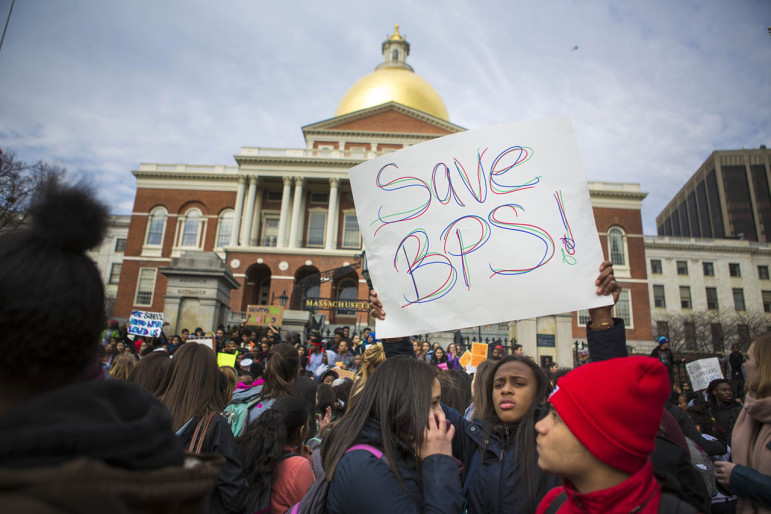
Just days after a large-scale walkout of students across Boston over proposed districtwide budget cuts, Mayor Marty Walsh says high schools will be spared from reduced funding.
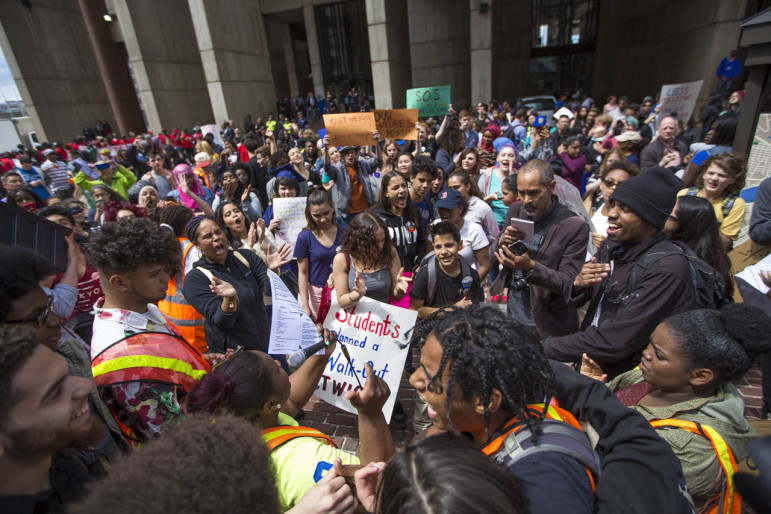
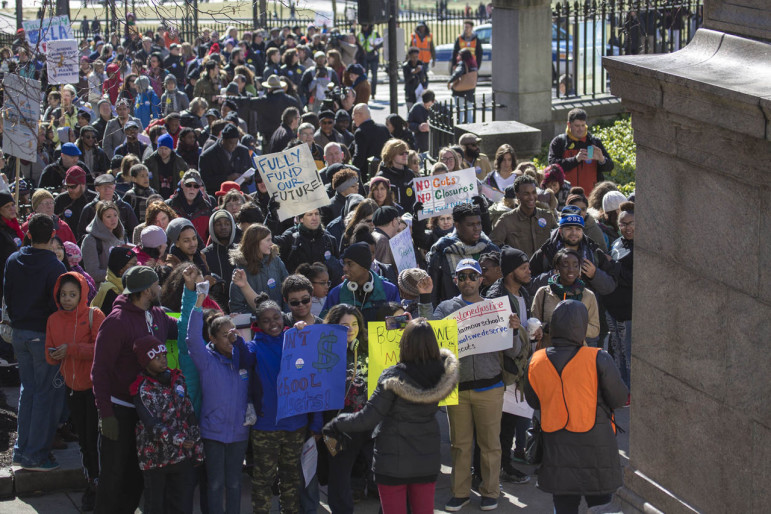
BOSTON -- “Welcome to the movement!” Marleana Rose of the Boston Justice Education Alliance announced to a crowd of more than 200 people gathered outside Boston City Hall for the Boston “Walk-In and Rally for Public Education," one of many held across the country Wednesday.
Students, teachers, parents and community members gathered to protest the proposed Boston Public Schools budget, which could fall short by $50 million. At the proposed level, district schools could lose teachers, after-school programs and elective classes like languages and arts.
Erik Lazo, 16, is a 10th-grader at Snowden International School in Back Bay. One of several students who spoke at the rally, Lazo talked about studying Japanese.
“One of the major reasons I entered that class was to learn that language," Lazo said. "And I eventually met some outstanding friends along the way and had some of the most exceptional and incomparable teachers too.”
But now, he said, if the school has to cut Japanese, his two years of study would be for naught. “Worthless.”
Increases in college costs and concerns about student debt have led to a variety of proposals for free tuition across American higher education.
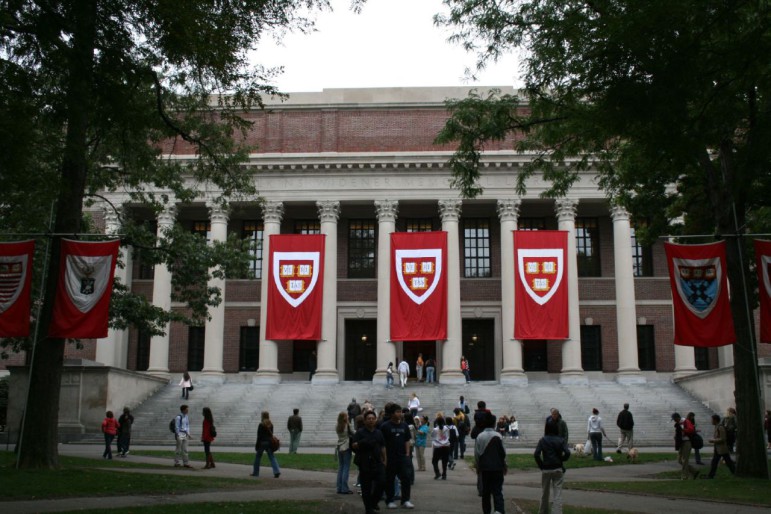
Several alumni hoping to be elected to Harvard University’s Board of Overseers are now campaigning on a platform of zero tuition for Harvard students. Other proposals focus on community college tuitions, which are already relatively low compared to other types of colleges and universities. And U.S. Rep. Tom Reed (R-N.Y.) is going after the country’s selective private colleges with large endowments. His draft legislation would require these schools to increase spending from their endowments in an effort to hold down tuition and reduce student debt burdens.
But who will actually benefit from these proposals?
Reducing tuition at the well-endowed schools would primarily benefit students from the top 20 percent of the income distribution, students and their families who can already pay much or all of the tuition. To help lower- and middle-income students and their families, it makes more sense to focus on expanding need-based financial aid, rather than lowering tuition levels.