Report: Boston Lacks 'Cultural Competence' In Teaching Black, Latino Males

BOSTON -- A new study identifies best practices in Boston schools that further the education of black and Latino males, but says, in general, Boston schools largely display a widespread lack of cultural competency when teaching those students.
While the study points to caring school cultures, professional collaboration, individualized instruction and family engagement as positive existing school practices, Rosann Tung, lead author of the study, says that in order to close achievement and opportunity gaps, more must be done.
"What we did not find was a systemic, school-wide approach to reaching black and Latino males and engaging them in their education," said Tung, who is also director of research and policy at Brown University's Annenberg Institute for School Reform.
The study is a collaboration among the Annenberg Institute, the Center for Collaborative Education, Boston Public Schools (BPS) and the Barr Foundation. It is part of an initiative to analyze the education of black and Latino males in Boston.
"While this study is specific to Boston, I want to be very clear, this is a national problem that must be addressed. I am very proud to see Boston at the forefront of this discussion," said John McDonough, interim superintendent for Boston schools.
Why Focus On Black And Latino Male Students?
This study is the second phase of a two-part study, which aims to examine the root causes and potential solutions to the achievement gaps that exist for black and Latino males in Boston schools.
The first phase, released in November, revealed stark opportunity gaps and a separate, lesser educational track for black and Latino males in Boston.
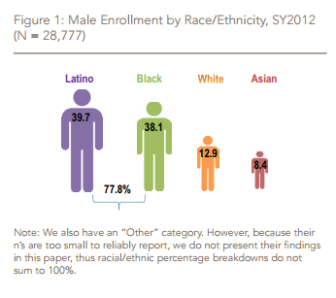
Black and Latino males collectively make up about 78 percent of Boston schools' male population.
At every stage of education, black and Latino males have limited access to rigorous coursework such as advanced work classes, elite exam schools and college readiness curricula.
As a result, the report says, black and Latino males in Boston schools have lower attendance rates, higher suspension and dropout rates, lower proficiency rates and lower graduation rates than peers.
Here are the numbers: White and Asian male students in Boston’s schools are 1.2 times more likely to graduate than their black male peers and 1.4 times more likely than Latino males.
Best Practices
This new report identified positive practices found at four Boston schools -- two elementary and two high schools -- where black and Latino students exhibited higher scores on standardized assessments.
Although these schools were identified as doing better than other Boston schools, all four schools posted proficiency rates below state averages. The high schools had higher suspension rates than the state average.
Still, the study identified productive practices consistently found in at least three of the four schools: caring school cultures, professional collaboration, individualized instruction and family engagement.
"There was a sense, throughout our interviews, that everybody was responsible for the success of the kids. Not just the teachers, but everybody in the building," said author Tung.
Strong schools created times for teachers to meet, collaborate and focus on problems that their students faced. In the classroom, when teachers modified lessons to accommodate diverse learning styles, interests and needs of students the results were positive.
One school with inclusion classrooms, meaning students with special needs are not separated from peers, had multiple adults present in classrooms, including at least one special education teacher. This method, Tung says, also saved struggling students without special needs from falling through the cracks.
"They were skilled at deploying their teachers in ways such that they could work together in the classroom but also in meetings during the school day to discuss the needs of individual kids or groups of kids," said Tung.
At the elementary school level, family engagement is key in a way Tung says is "not just participating in bake sales."
Instead, the study shows, the strongest schools give families a role in decision making and offer multiple ways for families to be engaged, both inside and outside the building, since family culture may influence their comfort with the school.
"[The schools] had an expectation that families would be involved not just at home," said Tung. "Families felt like they belonged."
A Widespread Lack Of Cultural Competency
Although the individual practices identified are hallmarks of effective schools, the study's authors note a lack of comprehensive, school-wide approaches to teaching black and Latino males.
Instead, the "best practices" occur in isolated pockets, within school settings that largely display a lack of cultural competency. School staff are aware that their students are black and Latino, but have limited knowledge of students' cultural and linguistic backgrounds.
The result: a largely superficial approach to multiculturalism.
For instance, one school decided to recognize the Latino culture at the school by celebrating a Mexican holiday, but had no Mexican students enrolled. In many cases, staff members conflated Latino students as one-in-the-same as English-language learners or referred to them as "the Spanish kids."
When researchers approached school staff, many were reluctant to speak about issues of race or gender in an explicit manner. Instead, many claimed that they were "colorblind" and not influenced by the racial and ethnic makeup of students.
"Those issues were not part of their curriculum or instruction," said Andres St. Rose, senior director of research, evaluation and policy for the Center for Collaborative Education. "In essence to say that you are colorblind is to make students of color, and, in this particular case, black and Latino male students, invisible."
Instead, researchers say, it is crucial that the diversity that students bring in terms of race, ethnicity, language and culture are celebrated and used in instruction.
"Having curriculum and instruction that really reflects the diversity of the student population and gives students an ability and a place to speak about these issues is critically important to engaging students of color at school," said St. Rose.
What About The Girls?
This study, notably, focuses only on the black and Latino males in schools and not on challenges faced by their female counterparts.
"If you respond to and help to meet the needs of the students that are doing the worst and put in practices that are going to help those students to excel, then you’re also going to be putting in practices for all students," Vivan Carlo, a co-author and researcher for the study, said. "So students that might not be doing as poorly as the male students, like the girls for instance, would also benefit."
Carlo, also an associate professor of education at Lesley University, believes more needs to happen to focus on the specific issues faced by girls in schools, but has confidence that this study will yield positive results for all at-risk students.
"This particular research study is groundbreaking, as long as there have been issues with the achievement of boys, black and brown boys in particular, there has not been any comprehensive study of this kind in any urban center," said Carlo. "To do an entire system the way that this particular study did is important."
Report Recommendations
The report recommends that the district implement culturally responsive curricula, communicate a level of high expectations to their schools, encourage discussions and professional development which explicitly addresses race and gender and to recruit and retain teachers that closely resemble the makeup of Boston's school population.
Tanisha M. Sullivan, chief equity officer for Boston schools, says that the district has been making strides to address achievement and opportunity gaps, and the new study confirms the need for a system-wide approach to using culturally relevant teaching practices.
"As we collectively have engaged in this work, we do recognize that before we can implement culturally relevant teaching practices, we need to level-set and need to engage in a constructive conversation about race to support this work," said Sullivan. "We've been working to bring race conversations into the district in a thoughtful and constructive way.
Those conversations will begin this spring. Sullivan also said that the district is currently developing training to support culturally-relevant teaching practices district-wide.