New Charter Schools Could Come To Boston
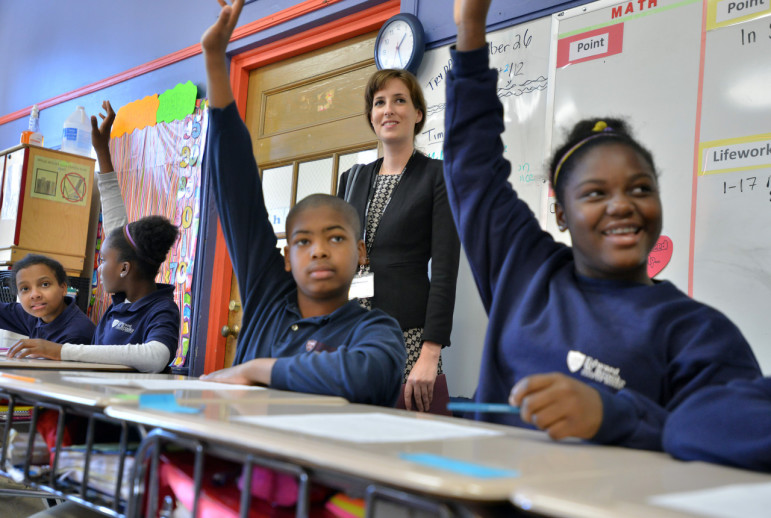
Boston could see new charter school seats for the first time since reaching a state-imposed charter limit in 2013.
This summer, the Department of Elementary and Secondary Education will accept charter applications for all school districts in the state except Somerville, Lawrence and Malden, which are at their charter limits. Charter operators may apply for new schools or to expand existing ones.
In a weekly update, state Education Commissioner Mitchell Chester projects that up to 668 charter school seats could be approved in Boston.
Boston currently hosts 34 of the state's 80 charter schools. Any new, approved charter schools could open by the fall of 2016, according to state education officials.
"There's an opportunity for additional seats that provide very high quality education to Boston students," said Linda Noonan, executive director of Massachusetts Business Alliance for Education, a charter school supporter. "Charter schools have flexibility and autonomy that have been shown to be tools that are necessary to respond to student needs."
When it comes to the number of students allowed in charter schools in a given area, as well as charter funding caps, it all comes down to the district's public school budget.
Under current law, the state may direct up to 9 percent of the money the district spends on students to fund seats at local charter schools. In low-performing school districts like Boston, the state can direct up to 18 percent of that spending to fund charter schools before it is capped.
The increase in charter seats in Boston is a reflection of Boston Public Schools' more than $1 billion budget for the 2016 school year -- the district's largest budget ever.
With more money in the district, the cap on charter spending -- and therefore seats -- rises. Yet, a larger budget in Boston doesn't necessarily mean extra funds.
While the 2016 school budget is the largest in Boston's history, the district still faces numerous spending shortfalls. To compensate, the district plans widespread cutbacks including closing two schools, cutting back food services and reducing services at the district's counseling center.
It's the potential transfer of funds to charter schools from districts facing shortages that worries Massachusetts Teachers Association President Barbara Madeloni.
"Districts like Boston, like Holyoke, they're losing so much money every year to charter schools and that's public money being put into private hands," Madeloni said. "It weakens the foundation of the schools. Above that we're not fully compensating districts when that happens."
The state has a fund to reimburse school districts for some of the money sent to charter schools, but the reimbursements do not fully offset the amount of money districts may give to charters.
This year, Boston is losing $15,000 for each of the 8,475 students who attend charter schools, about $104 million in all, after deducting limited state reimbursements.
“Boston Public Schools believes that all children deserve to attend a high-quality school near their home, whether that be a public or charter school," said Richard Weir, a spokesperson for Boston Public Schools. "Our mission is to make our schools places where every student receives a top-notch education and is given the academic tools to succeed in life.”
Statewide, local school districts paid about $367 million in charter tuition this year, after state reimbursements.