Kids in Boston and many other local districts go back to school the day after Labor Day. Others are already there. Either way, school always starts around now, and it always has, because kids had to spend the summer at work on the farm, right?
Not exactly.
"The agrarian model that dominated our educational landscape looked very different from what we have now," says Kenneth Gold, dean of education at the College of Staten Island. "That's just the prevailing myth."
In fact, the familiar September-to-June school year has almost nothing to do with farm kids.
BOSTON -- Schools in 11 Massachusetts school districts will receive $14 million in state grants to extend the time of the school day this year.
"Too often, our school year is insufficient to provide a strong, high-quality education," Mitchell Chester, commissioner of elementary and secondary education, said in a statement. "I am pleased to see schools take advantage of this opportunity to strengthen their programs for both students and teachers."
The grants will pay for at least 300 hours of additional learning time in each school. That time may be filled with more classroom instruction, enrichment opportunities for students, additional professional development for educators or a combination of these activities.
BOSTON -- Though a sailboat may be bigger than their parents' cars, young captains Valerie Geraldo and Wendy Santamaria operate the vessel with ease. They harness the wind and sail their 19-foot boat through Boston Harbor.
"I've been learning how to sail and how to pull the jib when we need to go to another direction," says Geraldo, a soon-to-be fourth grade student. "When you steer you need to go to the opposite side."
"My favorite part about sailing is that it helps you get your strength up," adds Santamaria, a soon-to-be fifth grade student. "Because you have to pull the mainsail and the jib -- and it's really heavy."
Geraldo and Santamaria are members of Courageous Sailing's "Swim, Sail, Science!" summer program run out of the Charlestown Navy Yard. The program, for soon-to-be fourth- and fifth-grade Boston students, has been operating since 2012 to give low-income youth lessons in swimming, sailing and science -- all at no cost to their families.
BOSTON -- The first time Devin Rich died, it was the night before Mother's Day 2014. He was 17, and he overdosed on a cocktail of codeine, prescription tranquilizers and other drugs.
When Rich woke up in the hospital at 6 p.m. the next day, his mother was sitting by his side. She had spent all of Mother's Day sitting next to him, crying and hoping that he would revive. But the first thing Rich noticed, he says, was that he no longer had his drugs.
"I didn't wake up feeling remorseful or guilty," says Rich. "I woke up angry because my drugs weren't in my pocket, my night was cut short and my friends didn't help me -- they called the cops."
Against medical advice, he ran out of the hospital. A subsequent court order required that he be treated for substance abuse, whether he agreed to it or not.
"Even at that time I wanted to get clean, because my life sucked and I was very depressed," says Rich. "But I wanted to get high more than I wanted to get clean. I wanted instant gratification. I wanted to feel better today for a couple hours, rather than feel better a couple months from now forever."
In June, little more than a year later, Rich graduated sober from one of Massachusetts' four publicly funded high schools for students in recovery. But before he could get there, he had to die again.
BOSTON -- Recent state standards that called for bans on sugary sodas, potato chips and other vending machine snacks in schools are working, says a study published Wednesday.
The study looked at "competitive" food available in school -- foods offered for sale beyond the standard school meals and typically found in school stores, vending machines or a la carte lines. It found that Massachusetts schools are offering significantly fewer foods that fail to meet the standards.
"What we showed in our Massachusetts data is that schools are able to implement the standards effectively with very little technical assistance, with no financial assistance," said Jessica Hoffman, a Northeastern associate professor and the study's lead author.
BOSTON -- It's 2015, college is expensive and costs are only rising. We all know a high school student who won't be able to afford college, a college student hoping the next few years will be worth the financial burden or a college graduate saddled with debt.
But Massachusetts Budget and Policy Center (MassBudget) hopes to see that change in the Bay State.
In a report released this week, the Boston-based policy analysis group explores options that would make public higher education in Massachusetts have a much more affordable price tag: free.
The options they explore would come with a cost of between $325 million and $631 million a year for the state, with various methods of eliminating tuition and fees for in-state students at community colleges and state universities.
"Making higher education much more affordable and making it possible for kids to graduate debt-free would not only help those kids and our economy, but it's something that could be done at a reasonable cost," said Noah Berger, president of Massachusetts Budget and Policy Center.
With an estimated 150,000 undocumented immigrants living in Massachusetts, a legislative push is under way to expand access to in-state college tuition rates and state financial aid to undocumented students. Advocates say it could affect an estimated 20,000 students in the state.
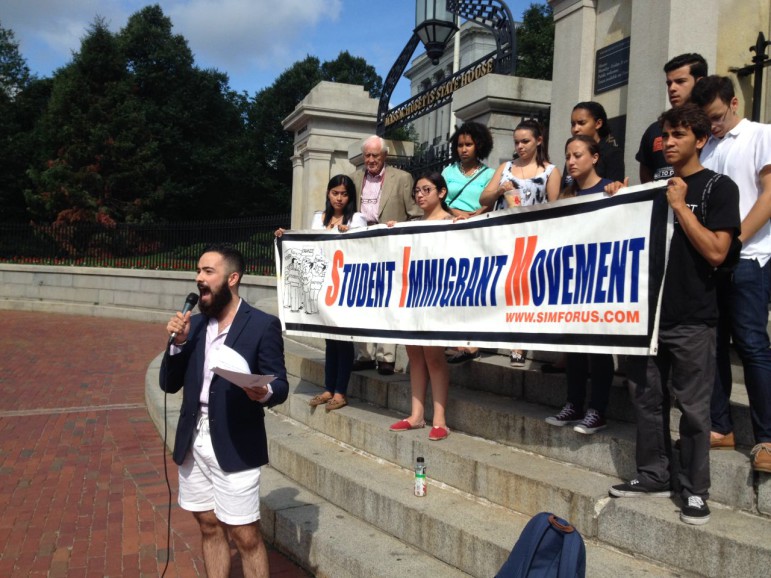
At a hearing Wednesday before the Joint Committee on Higher Education at the State House, nearly 200 people, mostly young students, packed the room to support House and Senate bills sponsored by Rep. Denise Provost (D-Somerville) and Sen. Sonia Chang-Diaz (D-Boston), respectively.
The bills would each allow students who completed at least three years of high school in Massachusetts to access in-state tuition and state financial aid at allMassachusetts colleges and universities -- regardless of immigration status.
While many states and school districts show significant gains in student achievement, poor students and students of color are still given fewer opportunities to succeed.
That's the troubling news from "Giving Every Child a Fair Shot," a White House report released this week as Congress takes up potential revisions to the nation's most far-reaching education law. The report highlights national trends from the 2012-13 school year, the most recent year for which federal nationwide data is available.
Activists and legislators who oppose Common Core are launching a campaign to put it to a vote on the 2016 Massachusetts ballot. Their proposed ballot question would drop Common Core as the state's education standard and return to the standards Massachusetts previously developed and used.
"The purpose of the ballot question is to restore the previous standards we had in the state, the pre-Common Core standards," said Sandra Stotsky, former senior associate commissioner at the Massachusetts Department of Elementary and Secondary Education, who's supporting the ballot effort.
The move comes as the state Board of Elementary and Secondary Education considers whether to switch from the Massachusetts Comprehensive Assessment System (MCAS) to the Partnership for Assessment of Readiness for College and Careers (PARCC) tests. Both systems are aligned to the Common Core standards.
Gov. Charlie Baker said Tuesday he doesn't see a need for Education Commissioner Mitchell Chester to recuse himself from the decision on whether to replace the MCAS standardized test with the new PARCC exams.
Chester has been criticized for chairing the governing board of the group that developed the PARCC exams while leading the Massachusetts Department of Elementary and Secondary Education. The latest call for him to step out of the decision came Tuesday from the Boston-based Pioneer Institute, a free-market-focused think tank.
Baker, however, said he doesn't think Chester's position "renders him unable to participate in the conversation," in part because the decision, expected this fall, would ultimately be up to the Board of Elementary and Secondary Education (BESE). Chester's role is to make a recommendation to the board.