Mitchell Chester, state commissioner of elementary and secondary education, recommended Friday that Southbridge Public Schools go into state receivership.
If the state board of education approves his recommendation, Southbridge would join Holyoke and Lawrence to become the third Massachusetts district in five years to be taken over by the state.
Citing continued "low academic performance, low graduation rates and unstable leadership," as well as high suspension rates and failure to comply with regulations on teaching English language learners, Chester said in a statement that the district falls short of its duty to provide an effective education.
BOSTON -- Boston Community Leadership Academy may not have much of a leadership program next year.
Or a library. Or gym class. Or four of its current teachers.
If the Hyde Park high school’s proposed 2016-17 budget is approved, BCLA will start the school year with a projected shortfall of more than $870,000. That’s 19 percent of its current operating budget, and it would force cuts to just about every program that is not required by law.
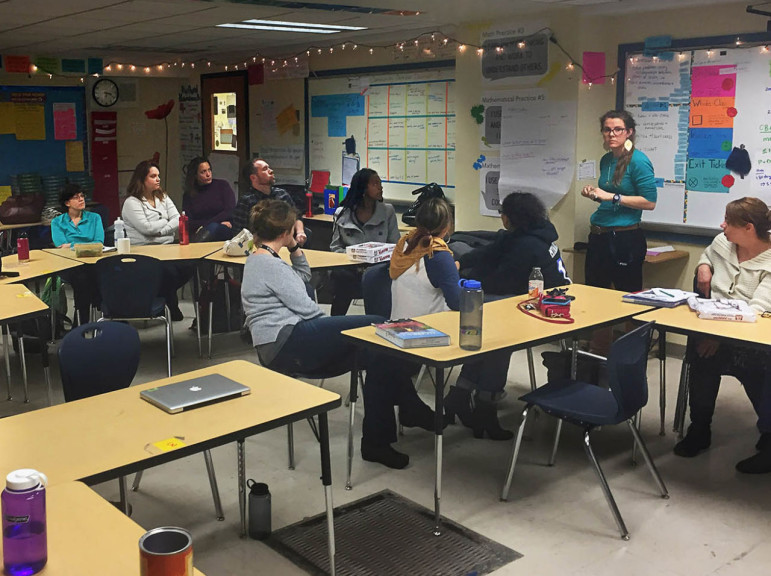
"It's a position from history, it's a position from science, a position from math, the rest of the library, the leadership coordinator,” math teacher Grace Evans told about 25 fellow teachers at a meeting last week. “It's gym..." The list goes on.
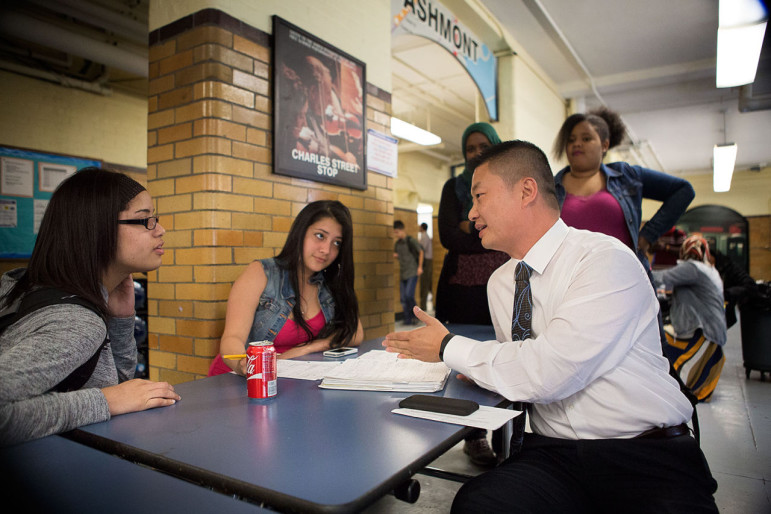
BOSTON -- Superintendent Tommy Chang said Tuesday that Boston Public Schools could fall short by as much as $50 million next year.
BPS will not close any schools in the 2016-17 school year, Chang pledged in a letter to parents.
"We have chosen not to close schools in this current budget," Chang wrote. "Closing schools must be a deliberate process based on equity of access and student needs."
Last year, budget cuts led to the closing of two schools in Hyde Park. This year, Chang said the district has already identified $20 million to cut in central departments and investments.
BOSTON -- Massachusetts has the best public school system in the country but could do more to help low-income students, according to a new report that ranks states by the quality of their public schools.
Education Week's annual national report, Quality Counts, gave Massachusetts the top spot because it has the nation's top fourth- and eighth-grade reading and math scores, high postsecondary degree attainment and rising AP test scores.
Massachusetts has ranked No. 1 every year since the index began in 2008.
Mitchell Chester, commissioner of elementary and secondary education, said he's "very proud" of the ranking.
"We've focused on doing well; we've focused on aiming high in terms of our academic expectation," said Chester. "Our educators have done the smart, hard work that has put us at the top."
Education is always a hot topic in Massachusetts, but this year it seemed to be on fire. Here are a few of the hot spots -- and perhaps the hottest is standardized testing.
By last school year, more than half of Massachusetts school districts had piloted a new standardized test called PARCC. These took the place of the MCAS tests given in Massachusetts schools since 1998. PARCC is more closely aligned to Common Core standards and can be given on computers.
Over the year, teachers and administrators provided feedback on PARCC, and multiple studies were done to study the new test’s effects.
It all laid the groundwork for the Board of Elementary and Secondary Education’s November vote on whether the state should adopt a new standardized test. Teachers, parents, students, policymakers -- everyone seemed to have a pro-MCAS or pro-PARCC stance.
But much of the controversy surrounded one figure: Mitchell Chester, Massachusetts commissioner of elementary and secondary education.
It's one of parenting's great mysteries. How can that bright-eyed grade-schooler, bouncing out of bed at 6 a.m., morph into a groggy, irritable teenager who burrows back under the sheets and begs for just five more minutes?
Turns out the cranky teen actually has a valid claim, rooted in biology, that doctors say high schools ignore by starting too early. Both the American Academy of Pediatrics and the Massachusetts Medical Society say a lack of sleep can hurt students.
They recommend that middle and high schools start no earlier than 8:30 a.m.
More than 75 percent of high schools in Massachusetts now start before 8 a.m. But many districts are beginning to think about pushing their start times later.
It's certainly been a long time coming. The new federal education law, the Every Student Succeeds Act, was signed into law last week by President Obama.
The long-awaited replacement of George W. Bush's unpopular No Child Left Behind still requires annual testing, but it lets states and districts control many decisions about how to use those test results. It also reworks many aspects of federal involvement in education -- including teacher preparation, special education, teaching English-language learners and academic standards.
The new law itself may not "solve" any issues in education. Instead, as the new law gives states more control over education matters, how it's rolled out could produce varied effects in individual states.
It's very early on, but here are six things to keep an eye on in Massachusetts -- things that will, won't or might change:
BOSTON -- The Massachusetts Board of Elementary and Secondary Education will consider closing a Dorchester charter school, after years of poor academic results that have shown little improvement.
Education Commissioner Mitchell Chester recommended closing Dorchester Collegiate Academy Charter School in a Dec. 9 memorandum, two years after the board placed the school on probation. The board will vote on revoking the school's charter in its January meeting.
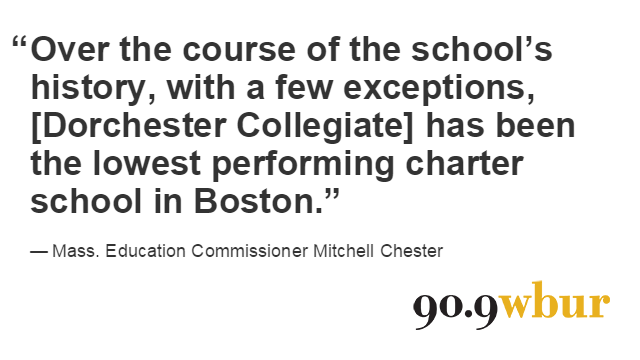
"Over the course of the school’s history," writes Chester, "with a few exceptions, [Dorchester Collegiate] has been the lowest performing charter school in Boston."
Chester cites the school's low test scores, high attrition rates and lackluster enrollment as reasons to close the seven-year-old charter school, which serves about 200 students in grades 4-8.
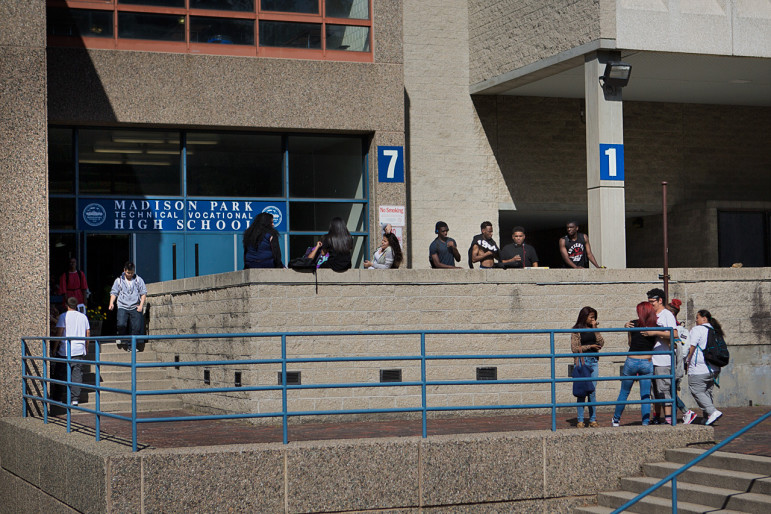
Massachusetts education officials on Wednesday designated a long-troubled Boston vocational high school as "underperforming," as they released annual state accountability results for schools across the state.
Madison Park Technical Vocational High School is the only newly identified underperforming school this year, a shift from last year when six schools were given that status. There are 15 schools in total labeled as underperforming.
The distinction is based on tests scores, plus graduation and dropout data.
The vast majority of Boston Public Schools (BPS) did not see their status change. Three BPS schools significantly improved. Madison Park is one of five Boston schools that saw their accountability status decline.
Boston Superintendent Tommy Chang said the district is aware that Madison Park has long been underperforming and that the rating could help "galvanize" a plan already in place to vastly improve the school.
BOSTON -- There's little doubt that skills that can't be measured by standardized tests still play a pretty big role in a student's education.
Skills like self-confidence, the ability to work well with others, attitudes toward learning, and control over one's emotions. Beyond making day-to-day life easier to navigate, these skills have long term effects in one's life.
They're associated with high school and college success, likelihood of future employment, higher earnings, positive health and smaller chances of incarceration. In fact, being proficient in those non-academic skills can result in impacts 40 years down the line, according to a report released Tuesday by Boston-based education nonprofit Transforming Education (TransformEd).
"The skills students need to become successful not just in school, but in their careers and their lives, include, very significantly, a set of skills that are not the focus of schools when [schools] only look at test scores," said Christopher Gabrieli, TransformEd co-founder and chairman.
Gabrieli, a one-time gubernatorial candidate, is also co-founder of the National Center on Time & Learning and a major player in the expanded learning time movement. He says his work in expanding the school day raised a very specific question: What skills do students really need?
While there is mounting evidence from researchers of the importance of these non-cognitive skills, there are a number of challenges when it comes to deliberately teaching, learning and measuring them in schools.