Learning Lab
This is an archive of WBUR’s Learning Lab, which covered education in Massachusetts from 2013 to 2016.

Reporter's Notebook

Reporter's Notebook

How Much It Would Cost To Make College Free In Massachusetts... Or At Least Less Expensive

BOSTON -- It's 2015, college is expensive and costs are only rising. We all know a high school student who won't be able to afford college, a college student hoping the next few years will be worth the financial burden or a college graduate saddled with debt.

But Massachusetts Budget and Policy Center (MassBudget) hopes to see that change in the Bay State.

In a report released this week, the Boston-based policy analysis group explores options that would make public higher education in Massachusetts have a much more affordable price tag: free.

The options they explore would come with a cost of between $325 million and $631 million a year for the state, with various methods of eliminating tuition and fees for in-state students at community colleges and state universities.

"Making higher education much more affordable and making it possible for kids to graduate debt-free would not only help those kids and our economy, but it's something that could be done at a reasonable cost," said Noah Berger, president of Massachusetts Budget and Policy Center.
Read more of How Much It Would Cost To Make College Free In Massachusetts... Or At Least Less Expensive →

Reporter's Notebook

Senate's Revised Education Bill Passes, Without Warren's Vote

Sen. Elizabeth Warren (D-Mass.) was one of just three Democrats to vote against the Every Child Achieves Act, the Senate's revision of the education law known as No Child Left Behind, which passed Thursday by a vote of 81-17.

While she called the measure "a significant improvement in federal education policy," Warren said in a statement that it "eliminates basic, fundamental safeguards to ensure that federal dollars are actually used to improve both schools and educational outcomes for those students who are often ignored."

Warren supported the bill in committee because, she said, she was promised that "it would improve." But "in the past two weeks, Republicans have blocked every attempt to establish even minimum safeguards to ensure that money would be used effectively," she said. "I cannot support this legislation until this critical issue is meaningfully addressed."

Read more of Senate's Revised Education Bill Passes, Without Warren's Vote →

Reporter's Notebook

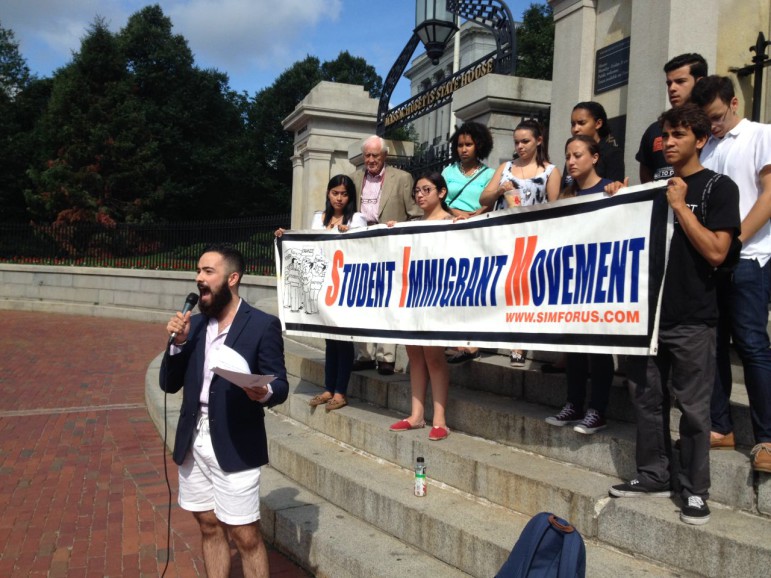
Undocumented Students Push State For College Aid

With an estimated 150,000 undocumented immigrants living in Massachusetts, a legislative push is under way to expand access to in-state college tuition rates and state financial aid to undocumented students. Advocates say it could affect an estimated 20,000 students in the state.

At a hearing Wednesday before the Joint Committee on Higher Education at the State House, nearly 200 people, mostly young students, packed the room to support House and Senate bills sponsored by Rep. Denise Provost (D-Somerville) and Sen. Sonia Chang-Diaz (D-Boston), respectively.

The bills would each allow students who completed at least three years of high school in Massachusetts to access in-state tuition and state financial aid at all Massachusetts colleges and universities -- regardless of immigration status.

Read more of Undocumented Students Push State For College Aid →

Reporter's Notebook

As Congress Debates 'No Child Left Behind,' White House Finds Achievement Gaps

While many states and school districts show significant gains in student achievement, poor students and students of color are still given fewer opportunities to succeed.

That's the troubling news from "Giving Every Child a Fair Shot," a White House report released this week as Congress takes up potential revisions to the nation's most far-reaching education law. The report highlights national trends from the 2012-13 school year, the most recent year for which federal nationwide data is available.

Read more of As Congress Debates 'No Child Left Behind,' White House Finds Achievement Gaps →

Reporter's Notebook

Group Launches 'End Common Core' Ballot Effort

Activists and legislators who oppose Common Core are launching a campaign to put it to a vote on the 2016 Massachusetts ballot. Their proposed ballot question would drop Common Core as the state's education standard and return to the standards Massachusetts previously developed and used.

"The purpose of the ballot question is to restore the previous standards we had in the state, the pre-Common Core standards," said Sandra Stotsky, former senior associate commissioner at the Massachusetts Department of Elementary and Secondary Education, who's supporting the ballot effort.

The move comes as the state Board of Elementary and Secondary Education considers whether to switch from the Massachusetts Comprehensive Assessment System (MCAS) to the Partnership for Assessment of Readiness for College and Careers (PARCC) tests. Both systems are aligned to the Common Core standards.

Read more of Group Launches 'End Common Core' Ballot Effort →

Reporter's Notebook

Amid Concerns, Baker Says Chester Belongs 'In The Conversation' On PARCC

Gov. Charlie Baker said Tuesday he doesn't see a need for Education Commissioner Mitchell Chester to recuse himself from the decision on whether to replace the MCAS standardized test with the new PARCC exams.

Chester has been criticized for chairing the governing board of the group that developed the PARCC exams while leading the Massachusetts Department of Elementary and Secondary Education. The latest call for him to step out of the decision came Tuesday from the Boston-based Pioneer Institute, a free-market-focused think tank.

Baker, however, said he doesn't think Chester's position "renders him unable to participate in the conversation," in part because the decision, expected this fall, would ultimately be up to the Board of Elementary and Secondary Education (BESE). Chester's role is to make a recommendation to the board.

Read more of Amid Concerns, Baker Says Chester Belongs 'In The Conversation' On PARCC →

Reporter's Notebook

For Students With Disabilities, Transition From High School Brings Unique Challenges

Any way you look at it, the end of high school is an emotional time: there's the elation of graduation, the bittersweet goodbyes to teachers and peers, and the creeping apprehension of closing the door on a familiar life and stepping into a new phase.

For the 6 million U.S. students diagnosed with disabilities, the transition out of high school can be a nerve-wracking and challenging experience.

It's what some educators and advocates call "falling off the cliff" -- when students, at age 22 or when they finish high school, lose entitlement to the special education services and support systems that have kept them afloat.

Read more of For Students With Disabilities, Transition From High School Brings Unique Challenges →

Reporter's Notebook

For 20th Year, Boston Provides Free Summer Meals For Youth

BOSTON -- School's out for the summer. For students it may mean a long-awaited break from endless homework, standardized testing and bus rides to school.

It also means a break from noisy school cafeterias and school lunches. But what about the roughly 43,000 Boston students who may rely upon their free and reduced meals to get food?

To address this, Boston Public Schools (BPS) on Wednesday kicks off its 20th summer of providing free meals to Boston children.

From July 1 through Aug. 28, free breakfast and lunch will be available at over 120 locations throughout the city. All Boston youth, 18 and under, are eligible to receive the two meals offered each weekday at the Boston sites.

The meal program is accompanied by phone (1-800-645-8333) and text (617-863-MEAL) hotlines that youth and families may use to find their nearest free meal options.

Read more of For 20th Year, Boston Provides Free Summer Meals For Youth →

Reporter's Notebook

U.S. Report: Mass.' Revised Method To Track Student Poverty Is Insufficient

BOSTON -- A federal guide for education agencies that outlines ways to identify student socioeconomic status says that Massachusetts' new method to track student poverty is not sufficient on its own.

As we reported Tuesday, Massachusetts has scrapped a decades-long practice of using free or reduced price lunch eligibility as a measure of student income. Instead, a student is now termed “economically disadvantaged” by the state if the student receives specific public benefits, including food stamps or foster care.

As a result, the number of students identified as poor has fallen dramatically.

The guide, released Monday by the National Forum on Education Statistics, offers Massachusetts' new method as one way to measure socioeconomic status, but says given the method's limitations, it should be used in combination with other measurements.

Read more of U.S. Report: Mass.' Revised Method To Track Student Poverty Is Insufficient →

Reporter's Notebook

State To Receive Initial Report On Adequately Funding Public Schools

The state committee that will craft recommendations for how the state should adequately fund public schools approved a preliminary report to submit to the Massachusetts Legislature on Tuesday.

At the State House meeting of the Foundation Budget Review Commission (FBRC), members put the final touches on a report that includes some initial findings on school districts' health care costs and spending on special education students.

The committee members also agreed to include in the report that the FBRC plans to analyze a number of other areas, including costs associated with lowering class sizes in early grades, wraparound services, extended learning time and educating English-language learners.

Read more of State To Receive Initial Report On Adequately Funding Public Schools →